The natural history of cow-pox and vaccinal syphilis / by Charles Creighton.
- Charles Creighton
- Date:
- 1887
Licence: Public Domain Mark
Credit: The natural history of cow-pox and vaccinal syphilis / by Charles Creighton. Source: Wellcome Collection.
Provider: This material has been provided by the Harvey Cushing/John Hay Whitney Medical Library at Yale University, through the Medical Heritage Library. The original may be consulted at the Harvey Cushing/John Hay Whitney Medical Library at Yale University.
64/176 page 60
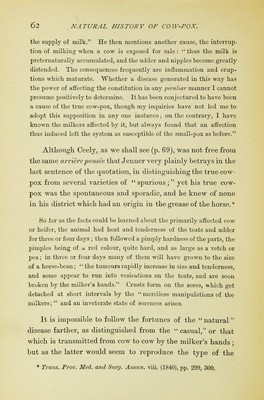
![negative writers, such as Moseley and Squirrel], resting their case on Jenner's own data, while the apologists, such as Ring, employed their whole skill in evading the questions naturally suggested thereby. The profession at large were supplied with lymph which, as at present, is only occasionally a source of serious mishap, and they were profoundly in- different whether ulceration, and secondary infection, were part of the complete natural history of cow-pox or not. Ceely takes the facts of cow-pox in what may be called their physiological order : (1) the spontaneous and sporadic disease in the cow; (2) the disease as communicated to the teats of other cows in the same shed by the medium of the milkers; and (3) the disease on the milkers' hands or faces. The spontaneous or sporadic disease was hardly ever seen by Ceely himself at or near the commencement; he had to depend on what he was told for his knowledge of its circumstances, and of its first symptoms. When an outbreak occurs in a cow-house, the milkers pretend, in general, to point out the infecting animal; many intelligent dairymen believe that it occurs more frequently as a primary disease among milch heifers. The following are two cases: In December, 1838, in a large dairy, a milch cow slipt her calf, had heat and indura- tion of the udder and teats, with vaccine eruption, and subsequent leucorrhcea and greatly impaired health; the whole of the dairy, con- sisting of forty cows, became subsequently affected, as well as some of the milkers. In another dairy it first appeared in a heifer, soon after her calf was weaned; in about ten or twelve days it was communicated to five other heifers and one cow in the same shed, the milkers being also affected. Of the spontaneous or autochthonous development of this malady in a cow now and again, Ceely makes no ques- tion. Several times, in his experience, the disease, when it had been once started in that autochthonous manner, went](https://iiif.wellcomecollection.org/image/b21028539_0064.jp2/full/800%2C/0/default.jpg)