Orthopaedia or a practical treatise on the aberrations of the human form / by James Knight.
- Knight, James, 1810-1887
- Date:
- 1874
Licence: Public Domain Mark
Credit: Orthopaedia or a practical treatise on the aberrations of the human form / by James Knight. Source: Wellcome Collection.
Provider: This material has been provided by the National Library of Medicine (U.S.), through the Medical Heritage Library. The original may be consulted at the National Library of Medicine (U.S.)
96/380
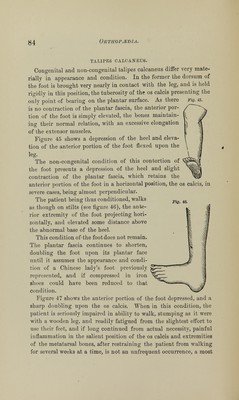
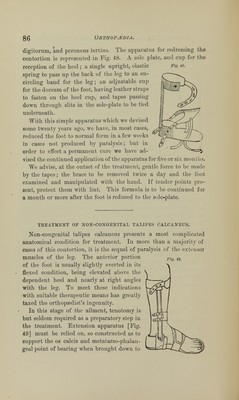
![digitorum, and peroneus tertius. The apparatus for redressing the contortion is represented in Fig. 48. A sole plate, and cup for the reception of the heel; a single upright, elastic Fig. 48. spring to pass up the back of the leg to an en- circling band for the leg; an adjustable cup for the dorsum of the foot, having leather straps to fasten on the heel cup, and tapes passing down through slits in the sole-plate to be tied underneath. With this simple apparatus which we devised some twenty years ago, we have, in most cases, reduced the foot to normal form in a few weeks in cases not produced by paralysis; but in order to effect a permanent cure we have ad- vised the continued application of the apparatus for five or six months. We advise, at the outset of the treatment, gentle force to be made by the tapes; the brace to be removed twice a day and the foot examined and manipulated with the hand. If tender points pre- sent, protect them with lint. This formula is to be continued for a month or more after the foot is reduced to the sole-plate. TEEATMENT OF NON-CONGENITAL TALIPES CALCANEUS. Fig. 49. Non-congenital talipes calcaneus presents a most complicated anatomical condition for treatment. In more than a majority of cases of this contortion, it is the sequel of paralysis of the extensor muscles of the leg. The anterior portion of the foot is usually slightly everted in its flexed condition, being elevated above the dependent heel and nearly at right angles with the leg. To meet these indications with suitable therapeutic means has greatly taxed the orthopaedist's ingenuity. In this stage of the ailment, tenotomy is but seldom required as a preparatory step in the treatment. Extension apparatus [Fig. 49] must be relied on, so constructed as to support the os calcis and metatarso-phalan- geal point of bearing when brought down to](https://iiif.wellcomecollection.org/image/b21135083_0096.jp2/full/800%2C/0/default.jpg)