Volume 1
A system of obstetric medicine and surgery : theoretical and clinical for the student and practitioner / by Robert Barnes and Fancourt Barnes.
- Date:
- 1884-1885
Licence: Public Domain Mark
Credit: A system of obstetric medicine and surgery : theoretical and clinical for the student and practitioner / by Robert Barnes and Fancourt Barnes. Source: Wellcome Collection.
Provider: This material has been provided by the Royal College of Physicians of Edinburgh. The original may be consulted at the Royal College of Physicians of Edinburgh.
605/624
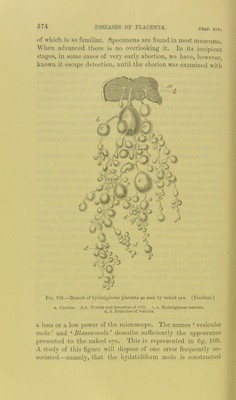
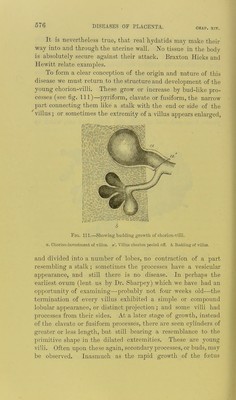
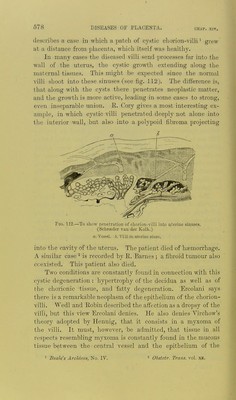
![towards the term of gestation is ever calling for increased ex- pansion of placenta, fresh villi are constantly forming. These buds are accordingly: seen on the villi of placentas approaching maturity; but they are far less frequent than in early ovt.. Now it appears that under the influences of a perverted de- velopmental force, these buds, instead of growing into villi, carrying blood-vessels, may dilate into true vesicles or hydatidi- form cysts. Such a perverted growth necessarily involves the destruction of the placenta as a respiratory organ, and the consequent death of the embryo. Having examined a great number of ova of different epochs, we have become familiar with various appearances which can neither be referred to healthy villi nor to hydatidiform degeneration. We have noted bodies attached to villi which, although evidently of the same origin as the ordinary budding villi, were yet so different in some of their characters as clearly to have failed as villi, and which, nevertheless, were not recognised as hydatidiform cysts. We are disposed to regard these as marking an intermediate stage or transition into cystic degeneration,' The more advanced stage is thus described by Paget: ' Certain of the proper villi of the chorion deviating from their cell-form, and increasing disproportionately in size, form cysts which remain connected by the gradually elongated and hyper- trophied tissue of the villi. On the outer surface of the new- formed cysts, each of which would, as it were, repeat the chorion and surpass its powers, a new vegetation of villi sprouts out of the same structure as the proper villi of the chorion. In this begins again a similar development of cysts, and so on ad in- finitum. Each cyst, as it enlarges, seems to lead to the wast- ing of the cells around it; and then moving away from the villus in which it was formed, it draws out the base of the villus, which strengthens itself, and forms the pedicle on which the cyst remains suspended.' The disease presents a curious example of a structure endowed with independent formative force con- tinuing to grow^a pure parasite—for itself alone, having ousted the original parasite, the embryo. The cystic degeneration generally attacks all the chorion- villi, including those not destined to form placenta. Michael ' ' On the Diseases of the Placenta,' Brit, and Foreign Med.-Chir. llcviciv, ] 85i -5-C. VOL. I. P P](https://iiif.wellcomecollection.org/image/b21980147_0001_0605.jp2/full/800%2C/0/default.jpg)