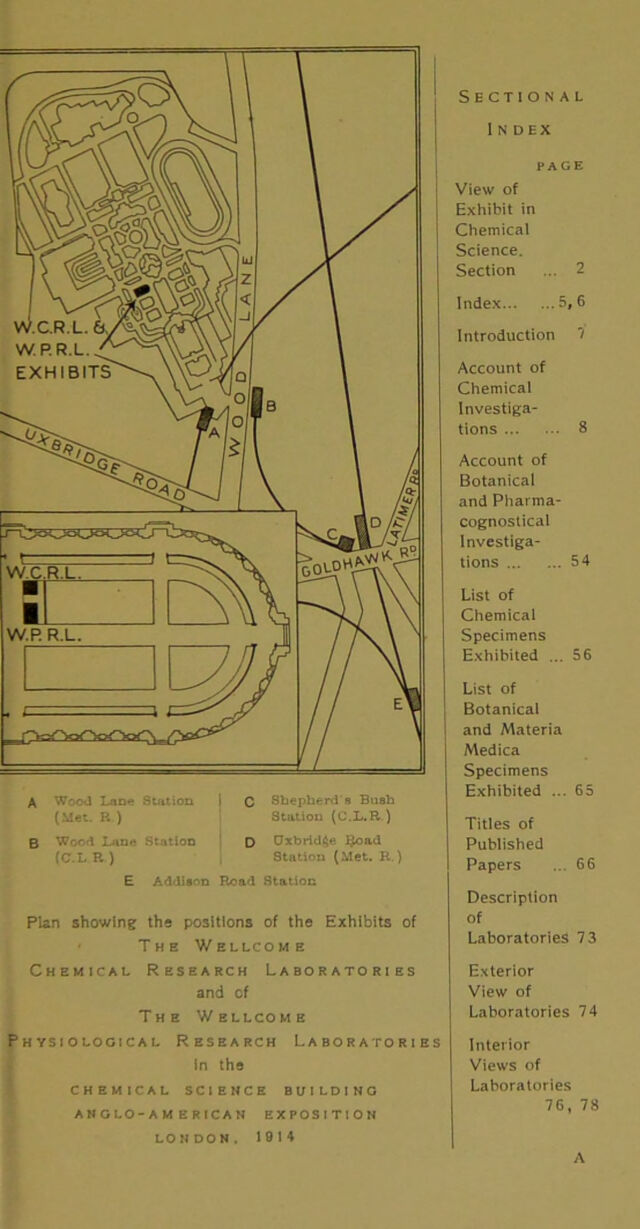
The Wellcome Chemical Research Laboratories, London.
- Frederick Belding Power
- Date:
- 1914
Licence: Attribution 4.0 International (CC BY 4.0)
Credit: The Wellcome Chemical Research Laboratories, London. Source: Wellcome Collection.
Provider: This material has been provided by The Royal College of Surgeons of England. The original may be consulted at The Royal College of Surgeons of England.
29/84 page 27
![ijglucoside, C]4H1?ObN (m.p. 145-147°; [<z] D—29-6°). In .addition to the latter compound, a number of other interesting substances have been isolated from the bark, among which may be mentioned a fluorescent principle, scopoletin, C10HsO,, which was evidently present in the form of its glucoside, aesculin monomethyl ether (Jottrti. Chew. Soc., 1909, 95, PP- 243-261). The leaves of Prunus serotina have also been subjected to a complete chemical examination, in order to compare their constituents with those of the bark. It has thus been ascertained that the leaves contain the same cyano- genetic compound as the bark, namely, /-mandelonitrile glucoside, but, as was anticipated, there are interesting differences with respect to the other constituents. Among the various substances isolated, in addition to the cyanogenetic glucoside, there may be mentioned hentria- contane, pentatriacontane, ceryl alcohol, a phytosterol glucoside, a new crystalline substance, C31HjsO.(OH)2, designated as priniol, benzoic acid, quercetin, and a new glucoside of the latter, C.2IH20O12,3H0O, which has been designated serotrin (Journ. Chew. Soc., 1910, 97, pp. 1099-1112). /jcAmygdalin AND THE RESOLUTION OF ITS 11EPT A-ACETYL DERIVATIVE Amygdalin is the name given to an optical isomeride of amygdalin, and it is obtained from the latter by treat- ment with dilute, aqueous alkalies. In this investigation bcamygdalin was acetylated, and, from the resulting product, hepta-acetylamygdalin and the hepta-acetyl derivative of the unknown isomeride were obtained, the latter isomeride having been designated wroamygdalin. Hepta-acetybmximygdalin (m.p. 174°; [«],,-65-6°), on hydrolysis with concentrated hydrochloric acid, yields af-mandelic acid, and it has thus been shown that all three varieties of mandelic acid may be obtained from amygdalin (Journ. Chew. Soc., 1909, 95, pp. 663-668).](https://iiif.wellcomecollection.org/image/b22486069_0031.jp2/full/800%2C/0/default.jpg)


 No text description is available for this image
 No text description is available for this image
 No text description is available for this image