A manual of botany : including the structure, classification, properties, uses, and functions of plants.
- Robert Bentley
- Date:
- 1887
Licence: Public Domain Mark
Credit: A manual of botany : including the structure, classification, properties, uses, and functions of plants. Source: Wellcome Collection.
Provider: This material has been provided by UCL Library Services. The original may be consulted at UCL (University College London)
874/960 (page 838)
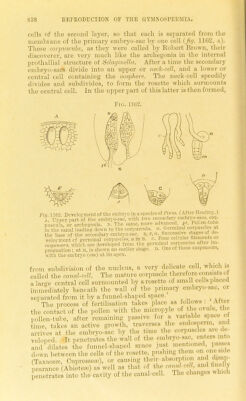
![cells of the second layer, so that each is separated from the lneinbiane of the primary embryo-sac by one cell (fig. 1102, a). These corpusculd, as they were called by Robert Brow n, their discoverer, are very much like the archegonia in the interna] prothallial structure of Sdacjinella, After a time the secondary embryo-sacs divide into an upper or neck-cell, and a lower or central cell containing the oosphere. The neck-cell speedily divides and subdivides, to form the rosette which surmounts the central cell. In the upper part of this latter is then formed, Fig. 11(52. Fid 11G Develormentof the embryo in a species of Pixus. (After Eenfrey.) 1. Upper part of the embryo-sac, with two secondary embryo-sacs, co£ pusciiia, or archegonia. B. The same, more advanced, pi, Pol.ei -tube in the canal leading down to the corpuscula. a. Germinal cornicle* at the base of the secondary embryo-sac. E, F, G. Successive stages o de- velo, ment cf germinal corpuscles, a in tf c. Four cellular fUaments or summon, which, are developed from the germinal ™JW*£«*^j£r pregnation ; at H, is shown an earlier btage. D. One of these suspensors, with the embryo (em) at its apex. from subdivision of the nucleus, a very delicate cell, which is called the canal-cell, The mature corpuscle therefore consist a. A a large central cell surmounted by a rosette of small cells placed immediately beneath the wall of the primary embryo-sac, or separated from it by a funnel-shaped space.' The process of fertilisation takes place as follows : After the contact of the pollen with the micropyle of the ovule, the pollen-tube, after remaining passive for a variable space of time, takes an active growth, traverses the endosperm, and arrives at the embryo-sac by the time the corpuscles are de- veloped. It penetrates the wall of the embryo-sac, enters into and dilates the funnel-shaped space just mentioned, passes down between the cells of the rosette, pushing them on one>side (Taxacere, Cupressere), or causing their absorption and fcaap- Larance (Abieteje) as well as that of the canal-cell, and finally ^eneSeilnto the cavity of the canal-cell. The changes which](https://iiif.wellcomecollection.org/image/b21687547_0874.jp2/full/800%2C/0/default.jpg)