A manual of botany : including the structure, classification, properties, uses, and functions of plants.
- Robert Bentley
- Date:
- 1887
Licence: Public Domain Mark
Credit: A manual of botany : including the structure, classification, properties, uses, and functions of plants. Source: Wellcome Collection.
Provider: This material has been provided by UCL Library Services. The original may be consulted at UCL (University College London)
876/960 (page 840)
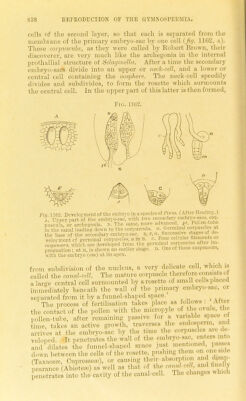
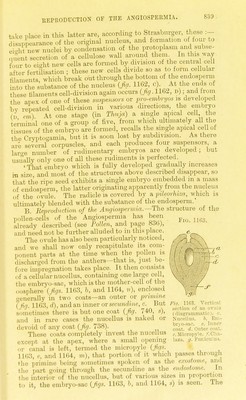
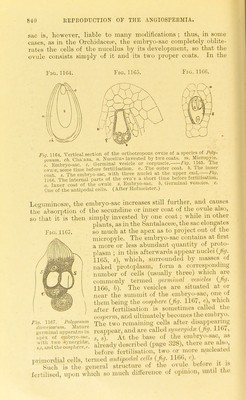
![sac is, however, liable to many modifications ; thus, in some cases, as in the Orchidace;ie, the embryo-sac completely oblite- rates the cells of the nucellus by its development, so that the ovule consists simply of it and its two proper coats. In the Fig. 11G4. Fig. 11G.3. Fig. 11GG. A M >v / Vs. ' rl > 11A «V\ I Fig 1164 Vertical section of the ortliotropous ovule of a species of Poly- gonum, ch. Cha'.aza. n. Nucellus invested by two coats, m. Micropyle. s Embryo-sac. c. Germinal vesicle or corpuscle. Fig. 1165. llie ovule some time before fertilisation, a. The outer coat. 6. The inner coat s The embryo-sac, with three nuclei at the upper end. tig. 1166* The internal parts of the ovu'e a short time before fertilisation. a Inner coat of the ovule, s. Embryo-sac. 6. Germinal vesicles, c. One of the antipodal cells. (After Hofmeister.) Leo-uminosfE, the embryo-sac increases still further, and causes the absorption of the secundine or inner coat of the ovule aba •, so that it is then simply invested by one coat; while in other plants, as in the Santalacese, the sac elongates so much at the apex as to project out of the micropyle. The embryo-sac contains at first a more or less abundant quantity of proto- plasm ; in this afterwards appear nuclei (Jiy. 1165, s), which, surrounded by masses of naked protoplasm, form a corresponding number of cells (usually three) which are commonly termed germinal vesicles {fig. 1166, b). The vesicles are situated al or near the summit of the embryo-sac, one of them being the oosphere (Jig. 1167, e), which after fertilisation is sometimes called the oosperm, and ultimately becomes the embryo. The two remaining cells after disappearing dimrfcatum. Mature ■*-v' , ,11 i .,,,,..,,;,/.. / 111:7 eermina] apparatus in reappear, and are called synergicta {Jig. llW, apex of embryo-sac, s A At the base of the embryo-sac, as ri^n.HheoospuIre*: already described (page 328), there are also »it, and the ooBphere, e. two or m0re nucleated primordial cells, termed (mtvpodal cells (fig. L166, c). Such is the general structure of the ovule before it is feitilised, upon which so much difference of opinion, until the Fig. 1167. Polygonum ijivarfcaium. Mature](https://iiif.wellcomecollection.org/image/b21687547_0876.jp2/full/800%2C/0/default.jpg)