Licence: Public Domain Mark
Credit: A few words on the art of filtration / by P.A. Maignen. Source: Wellcome Collection.
Provider: This material has been provided by London School of Hygiene & Tropical Medicine Library & Archives Service. The original may be consulted at London School of Hygiene & Tropical Medicine Library & Archives Service.
8/16 page 6
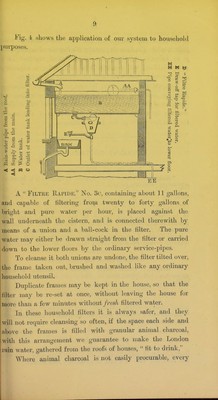
![being always kept charged with water (even when the flit is being cleansed), can serve only as conduits without ad dir anything to the vitality of the water passed through them ! It may be urged that this complete action is only of sho duration. True, the charcoal continues rapidly to arrest tl: impurities in suspension until the outer skin of charco; becomes clogged and the rate of filtering declines. But the the filter has given notice that it requires cleansing, an although the head on the filter may now be increased, n dangerous streamlets will appear in weak places as with san< for the filtration will continue perfect till, owing to the slo1 rate of filtration, it becomes compulsory to cleanse the filte This is simply done by removing the frames and smartl brushing off the charcoal in which the impurities have lodgec and from which they can afterwards be in part separated b washing and exposure to the sun. But the quantity c charcoal dust used in this way is so small, and the cost s little, that it would be as well to sell it for manure after first use, and charge the filter afresh with new charcoal. Of course the number of days that this charcoal wi] exert a chemical action will depend on the greater or lesse quantity of impurities in the water. Saussure has found that charcoal prepared from box woo absorbs during the space of twenty-four or thirty-six hours— 90 times its volume 85 35 9.35 1.75 >) )> >> » V of ammoniacal gas, hydrocloric acid, carbonic acid, oxygen, hydrogen. If the water were very impure the space between ea< and above the frames of the “ Filtjr,e Bapide ” could be fill* with broken lumps of wood charcoal or with granular anim charcoal, which has a more powerful action on organic math The fine sand used in ordinary beds appears to have two-fold action, that of straining and that of attracting particl](https://iiif.wellcomecollection.org/image/b24766367_0010.jp2/full/800%2C/0/default.jpg)