Description of a new artificial leg invented by Dr. Bly, of America : addressed to the medical profession / by H. Heather Bigg.
- Bigg, Henry Heather, 1826-1881.
- Date:
- 1864
Licence: Public Domain Mark
Credit: Description of a new artificial leg invented by Dr. Bly, of America : addressed to the medical profession / by H. Heather Bigg. Source: Wellcome Collection.
Provider: This material has been provided by The Royal College of Surgeons of England. The original may be consulted at The Royal College of Surgeons of England.
13/50 page 13
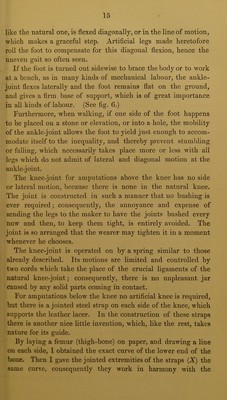
![]3 Fig. 1 is a section of Dr. Bly^s ball-and-socket-jointed ar- tificial leg. The ankle-joint is formed by a ball {B) of polished ivory, which is a joint that admits of every motion that the natural ankle does, without an exception. The cords (C) assume the position and functions of the natural tendons. Only three are shown in full, but the ends of all are seen in fig. 3. S is three of the five rubber springs which take the place of the muscles of the natural leg. N is the nuts, by which the tension of the cords and springs are regulated to suit the wearer. E is the spring which operates the knee-joint. Fig. 2 is a posterior view of the leg and thigh; the thigh in ! section—showing the knee cords {K) which takes the place of the crucial ligaments of the natural knee. Fig. 4 shows the curved joints (X) on either side of the knee, as constructed by Dr. Bly, for amputations below the knee. The curve corresponds with the natural knee, and allows the dress to set smoothly. And fig. 5 shows the joints {Y) for the same purpose, as con- structed by all other makers. Fig. 6. The right leg of this figure shows one of Dr. Bly’s artificial legs, worn by a mechanic, and flexed laterally at the ankle-joint, the same as a natural leg. It assumes every other position of the natural leg with equal facility. Fig. 7 represents the ankle-joint flexed diagonally, as is often the case when one side of the foot happened to be placed on a ! small stone or other obstacle. Fig. 8 shows the action of the ankle-joint when walking on • the side of a hill or on an inclined plain, the foot accommodating itself to the surface like the natural foot. The joints in this leg are made without iron or any kind of 1 metal, therefore the leg is extremely light, much lighter than ■ any other. The liability of metallic joints to rattle and make a I noise, after the leg has been worn a short time, is well known, ; and the annoyance which it causes the wearer at every step is ^ also well known. Now, as there is no metal about the joints in this leg, there is no noise. The ankle-joint is formed by a](https://iiif.wellcomecollection.org/image/b22345012_0013.jp2/full/800%2C/0/default.jpg)