Description of a new artificial leg invented by Dr. Bly, of America : addressed to the medical profession / by H. Heather Bigg.
- Bigg, Henry Heather, 1826-1881.
- Date:
- 1864
Licence: Public Domain Mark
Credit: Description of a new artificial leg invented by Dr. Bly, of America : addressed to the medical profession / by H. Heather Bigg. Source: Wellcome Collection.
Provider: This material has been provided by The Royal College of Surgeons of England. The original may be consulted at The Royal College of Surgeons of England.
44/50 page 44
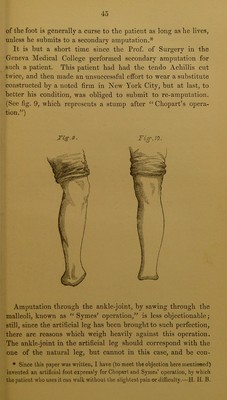
![[From the ‘ Transactions of the Medical Society of the State of New York.’] The Points of Election and Kind of Operation for Amputation of the Lower Extremities, with reference to the Use of Artificial Limbs. By Douglas Bly, M.D., Bochester, N. Y. POINTS OP ELECTION. Since an early period in surgery surgeons have recognised the importance of electing such points for amputation of the lower extremities as were best adapted to the application of artificial limbs. And many of the authors of works on surgery have given such points as were considered best adapted to the artificial limbs made at that time, but the great improvements which have been made in artificial limbs have materially changed the old points of election; therefore this subject demands the attention of surgeons generally. In accordance with the high state of perfection now attained in the construction of artificial limbs, all amputations performed on the foot should be anterior to the insertion of the flexors of the foot. The operation known as “ ChoparPs ” severs the flexors of the foot,- and should never be performed under any circumstances whatever. The moment the flexors are severed, the extensors, having no antagonists, draw the heel upwai’d, extend the foot on the leg, .and cause the amputated surface to point almost directly downward. This deprives the patient of all power to use the remaining portion of the foot, and also renders him incapable of wearing a useful substitute. I am aware that, to obviate this difficulty, some surgeons have severed the tendo Achillis, but that has proved inefiectualj it is only a partial relief at best. Therefore amputation at this point renders the patient a hopeless cripple. The wound is slow to heal, always tender, often ulcerating, and the remaining portion](https://iiif.wellcomecollection.org/image/b22345012_0044.jp2/full/800%2C/0/default.jpg)