Licence: Public Domain Mark
Credit: Aids to the study of the Maya codices / by Cyrus Thomas. Source: Wellcome Collection.
117/132 page 363
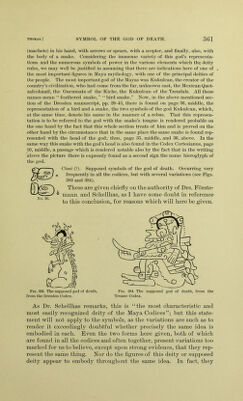
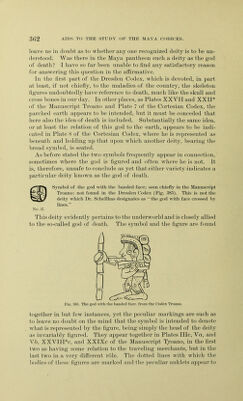
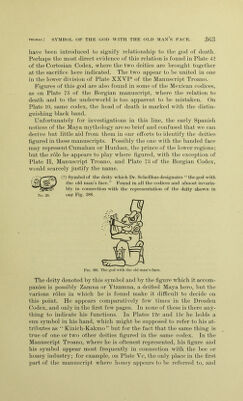
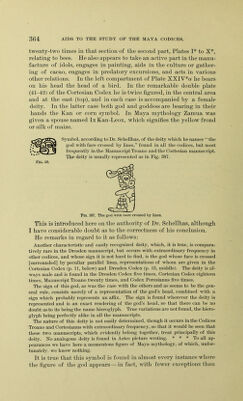
![thomas] SYMBOL OF THE GOD WITH THE OLD MAN’S FACE. 3G3 have been introduced to signify relationship to the god of death. Perhaps the most direct evidence of this relation is found in Plate 42 of the Cortesian Codex, where the two deities are brought together at the sacrifice here indicated. The two appear to be united in one in the lower division of Plate XXVI* of the Manuscript Troano. Figures of this god are also found in some of the Mexican codices, as on Plate 73 of the Borgian manuscript, where the relation to death and to the underworld is too apparent to be mistaken. On Plate 10, same codex, the head of death is marked with the distin- guishing black band. Unfortunately for investigations in this line, the early Spanish notices of the Maya mythology are so brief and confused that we can derive but little aid from them in our efforts to identify the deities figured in these manuscripts. Possibly the one with the banded face may represent Cumahau or Hunhau, the prince of the lower regions; but the role he appears to play where figured, with the exception of Plate II, Manuscript Troano, and Plate 73 of the Borgian Codex, would scarcely justify the name. No. 38. (?) Symbol of the deity which Dr. Schellhas designates “the god with the old man's face.” Found in all the codices and almost invaria- bly in connection with the representation of the deity shown in our Fig. 386. Fig. 386. The god with the old man’s face. The deity denoted by this symbol and by the figure which it accom- panies is possibly Zamna or Ytzamna, a deified Maya hero, but the various roles in which he is found make it difficult to decide on this point. He appears comparatively few times in the Dresden Codex, and only in the first few pages. In none of these is there any- thing to indicate his functions. In Plates 12c and 15c he holds a sun symbol in his hand, which might be supposed to refer to his at- tributes as “ Kinich-Kakmo ” but for the fact that the same thing is true of one or two other deities figured in the same codex. In the Manuscript Troano, where he is oftenest represented, his figure and his symbol appear most frequently in connection with the bee or honey industry; for example, on Plate Ve, the only place in the first part of the manuscript where honey appears to be referred to, and](https://iiif.wellcomecollection.org/image/b24882082_0117.jp2/full/800%2C/0/default.jpg)
 No text description is available for this image
 No text description is available for this image
 No text description is available for this image