Licence: Public Domain Mark
Credit: Aids to the study of the Maya codices / by Cyrus Thomas. Source: Wellcome Collection.
118/132 page 364
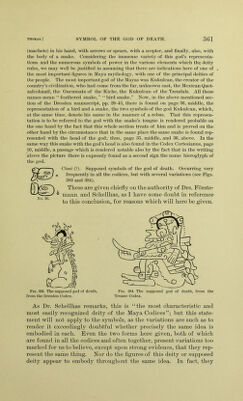
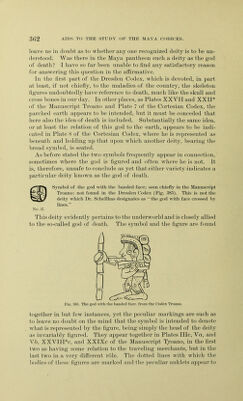
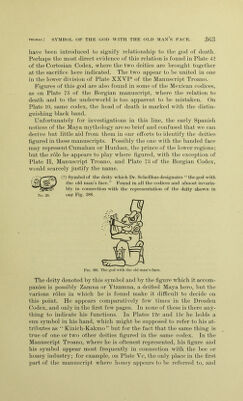
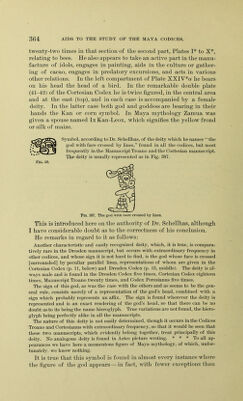
![twenty-two times in that section of the second part, Plates I* to X*, relating to bees. He also appears to take an active part in the manu- facture of idols, engages in painting, aids in the culture or gather- ing of cacao, engages in predatory excursions, and acts in various other relations. In the left compartment of Plate XXI V*a he bears on his head the head of a bird. In the remarkable double plate (41-42) of the Cortesian Codex he is twice figured, in the central area and at the east (top), and in each case is accompanied by a female deity. In the latter case both god and goddess are bearing in their hands the Kan or corn symbol. In Maya mythology Zamua was given a spouse named lx Kan-Leox, which signifies the yellow frond or silk of maize. Symbol, according to Dr. Schellhas, of the deity which he names “ the god with face crossed by lines,” found in all the codices, but most frequently in the Manuscript Troano and the Cortesian manuscript. The deity is usually represented as in Fig. 387. Fig. 387. The god with lace crossed by lines. This is introduced here on the authority of Dr. Schellhas, although I have considerable doubt as to the correctness of his conclusion. He remarks in regard to it as follows: Another characteristic and easily recognized deity, which, it is true, is compara- tively rare in the Dresden manuscript, but occurs with extraordinary frequency in other codices, and whose sign it is not hard to find, is the god whose face is crossed [surrounded] by peculiar parallel lines, representations of whom are given in the Cortesian Codex (p. 11, below) and Dresden Codex (p. 13, middle). The deity is al- ways male and is found in the Dresden Codex five times, Cortesian Codex eighteen times, Manuscript Troano twenty times, and Codex Peresianus five times. The sign of this god, as was the case with the others and as seems to be the gen- eral rule, consists merely of a representation of the god’s head, combined with a sign which probably represents an affix. The sign is found wherever the deity is represented and is an exact rendering of the god’s head, so that there can be no doubt as to its being the name hieroglyph. True variations are not found, the hiero- glyph being perfectly alike in all the manuscripts. The nature of this deity is not easily determined, though it occurs in the Codices Troano and Cortesianus with extraordinary frequency, so that it would be seen that these two manuscripts, which evidently belong together, treat principally of this deity. No analogous deity is found in Aztec picture writing. * * * To all ap- pearances we have here a momentous figure of Maya mythology, of which, unfor- tunately. we know nothing. It is true that this symbol is found in almost every instance where the figure of the god appears —in fact, with fewer exceptions than Fig, 39.](https://iiif.wellcomecollection.org/image/b24882082_0118.jp2/full/800%2C/0/default.jpg)
 No text description is available for this image
 No text description is available for this image
 No text description is available for this image