Licence: Public Domain Mark
Credit: A manual of the practice of medicine / by George Roe Lockwood. Source: Wellcome Collection.
Provider: This material has been provided by the Royal College of Physicians of Edinburgh. The original may be consulted at the Royal College of Physicians of Edinburgh.
945/988 page 899
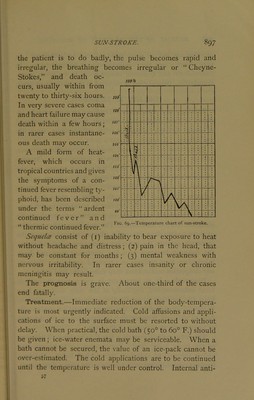
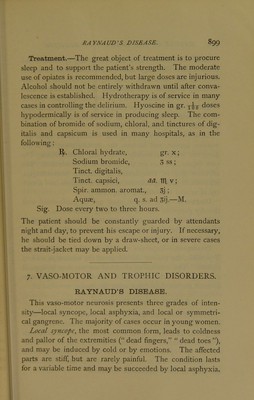
![Treatment.—The great object of treatment is to procure sleep and to support the patient’s strength. The moderate use of opiates is recommended, but large doses are injurious. Alcohol should not be entirely withdrawn until after conva- lescence is established. Hydrotherapy is of service in many cases in controlling the delirium. Hyoscine in gr. doses hypodermically is of service in producing sleep. The com- bination of bromide of sodium, chloral, and tinctures of dig- italis and capsicum is used in many hospitals, as in the following: ]$. Chloral hydrate, gr. x; Sodium bromide, 3 ss ; Tinct. digitalis, Tinct. capsici, aa. TTL v; Spir. ammon. aromat., 3j; Aquae, q. s. ad 3>j-—M. Sig. Dose every two to three hours. The patient should be constantly guarded by attendants night and day, to prevent his escape or injury. If necessary, he should be tied down by a draw-sheet, or in severe cases the strait-jacket may be applied. 7. VASO-MOTOR AND TROPHIC DISORDERS. RAYNAUD’S DISEASE. This vaso-motor neurosis presents three grades of inten- sity—local syncope, local asphyxia, and local or symmetri- cal gangrene. The majority of cases occur in young women. Local syncope, the most common form, leads to coldness and pallor of the extremities (“ dead fingers,” “ dead toes ”), and may be induced by cold or by emotions. The affected parts are stiff, but are rarely painful. The condition lasts for a variable time and may be succeeded by local asphyxia.](https://iiif.wellcomecollection.org/image/b2193339x_0945.jp2/full/800%2C/0/default.jpg)