The surgical treatment of suppurative pericarditis / by John B. Roberts.
- John Bingham Roberts
- Date:
- 1897
Licence: Public Domain Mark
Credit: The surgical treatment of suppurative pericarditis / by John B. Roberts. Source: Wellcome Collection.
Provider: This material has been provided by The Royal College of Surgeons of England. The original may be consulted at The Royal College of Surgeons of England.
23/28 page 19
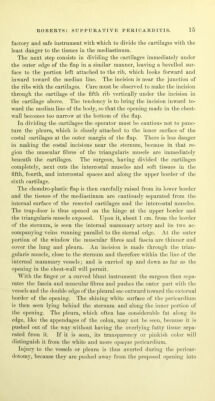
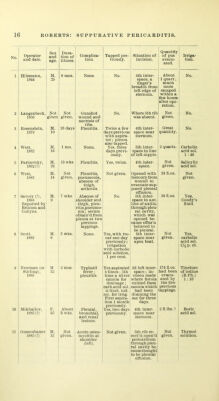
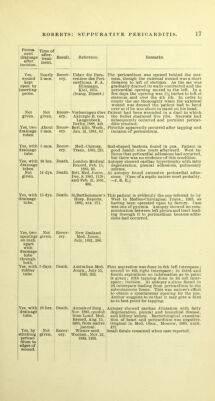
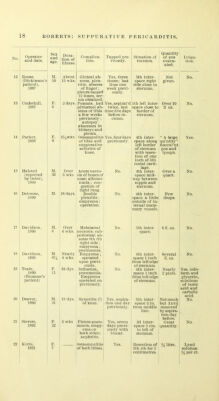
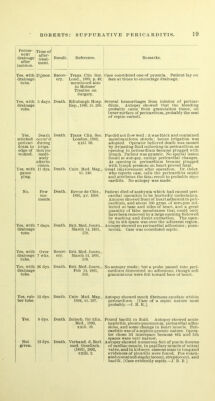
![Perma- nent drainage after incision. Time of after- treat- ment. Result. Reference. Remarks. Yes, with 2%mos. Recov- Trans. Clin Soc. Case considered one of pvaemia. Patient lay on drainage tube. ery. Lond., 1889, p. 48; mentioned also in Holmes’ Treatise on Surgery. face at times to encourage drainage. Yes, with drainage tube. 5 days. Death. Edinburgh Hosp. Rep., 1896, iv. 200. Several hemorrhages from interior of pericar- dium. Autopsy showed that the bleeding probably came from granulation tissue, on inner surface of pericardium, probably the seat of septic emboli. Yes, Death Death. Trans Clin. Soc. Pusdid not flow well ; it was thick and contained stitched occur’d London, 1889, membraniform shreds; hence irrigation was pericar- dium to edge of wound. during irriga- tion im- medi- ately afterin- cision. Death. xxii. 60. adopted. Operator believed death was caused by irrigating fluid collecting in pericardium,as opening in pericardium became plugged with lymph. Patient was pytemic. No special lesion found at autopsy, except pericardial changes. As opening in pericardium became plugged with lymph pressure on heart proved fatal. Great improvement after operation. Dr. Osier, who reports case, calls the pericarditis septic and attributes the fatai result to probable myo- carditis. No autopsy was made. Yes, with gauze plug. 17 dys. Univ. Med. Mag., vi. 248. No. Few mo- ments. Death. Revue de Chir., 1895, xv. 1008. Patient died of asphyxia which had caused peri- cardial operation to be hurriedly undertaken. Autopsy showed front of heart adherent to peri- cardium, and about 500 grms. of sero-pus col- lected at base and sides of heart, and a great quantity of false membranes that could only have been removed by a large opening followed by washing and direct extraction. The open- ing in 4th space was over the adherent region. Yes, with drainage tube. 7 days. Death. Brit. Med. Journ., March 14, 1891, 578. Autopsy showed no pericardial adhesions ; pneu- monia. Case was considered septic. Yes. with Over Recov- Brit. Med. Journ., drainage tube. 7 wks. ery. March 14, 1891, 578. Yes, with drainage tube. 26 dys. Death. Brit. Med. Journ., Feb 14, 1891, 350. No autopsy made; but a probe passed into peri- cardium discovered no adhesions, though soft granulations were felt toward base of heart. Yes, rub- ber tube. 13 dys. Death. Univ Med. Mag., 1894, vi. 297. Autopsy showed much fibrinous exudate within pericardium. [Case of a septic nature most probably.—J. B. R.]. Yes. 8 dys. Death. Zeitsch. fur klin. Med , 1893, xxiii. 26. Found bacilli in fluid. Autopsy showed acute nephritis, pleuro-pneumonia, pericardial adhe- sions, and some change in heart muscle. Peri- carditis was of a septico-pyemic nature. Opera- tor chose 3d interspace because 4th and 5th spaces were verv narrow. Not given. 12 dys. Death. Verhand. d. Berl. med. Gesellsch. (1892), 1893, xxiii. 2. Autopsy showed numerous foci of pus in fissures of cardiac muscle, in papillary muscle of mitral valve, and in kidneys; caseous mass in lung and evidences of pleuritis were found. Pus evacu- ated contained staphylococci, streptococci, and bacilli. [Case evidently septic.—J. B. R j](https://iiif.wellcomecollection.org/image/b22379484_0027.jp2/full/800%2C/0/default.jpg)