The mechanical treatment of compound and suppurating fractures occurring at the seat of war / by Robert Jones.
- Robert Jones
- Date:
- 1915
Licence: Public Domain Mark
Credit: The mechanical treatment of compound and suppurating fractures occurring at the seat of war / by Robert Jones. Source: Wellcome Collection.
3/24
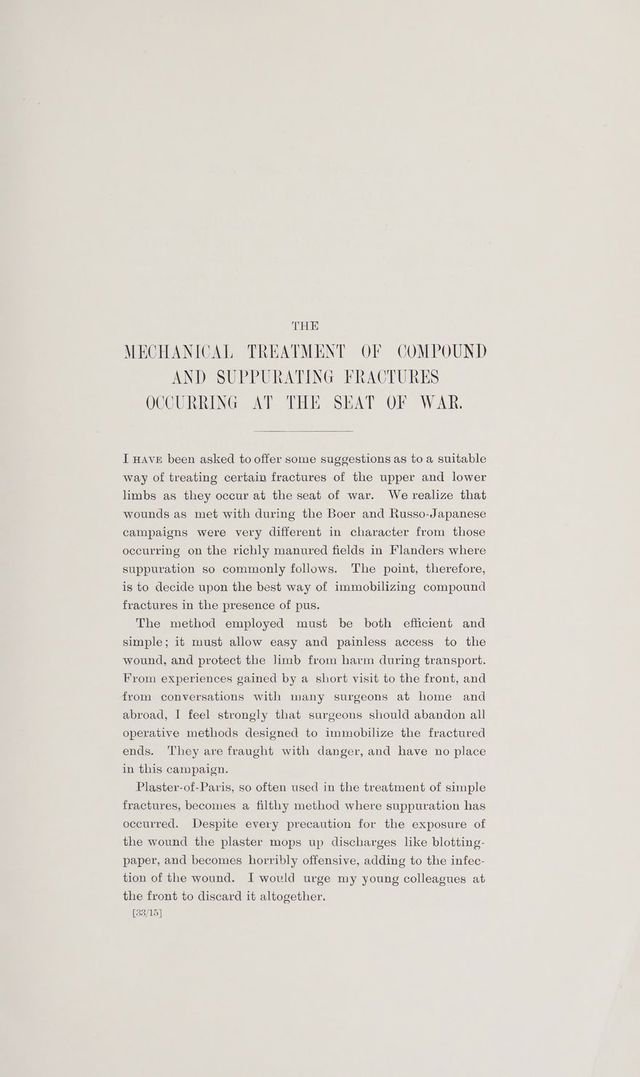
![THE MECHANICAL TREATMENT OF COMPOUND AND SUPPURATING FRACTURES OCCURRING AT THE SEAT OF WAR. I HAVE been asked to offer some suggestions as to a suitable way of treating certain fractures of the upper and lower limbs as they occur at the seat of war. We realize that wounds as met with during the Boer and Russo-Japanese campaigns were very different in character from those occurring on the richly manured fields in Flanders where suppuration so commonly follows. The point, therefore, is to decide upon the best way of immobilizing compound fractures in the presence of pus. The method employed must be both efficient and simple; it must allow easy and painless access to the wound, and protect the limb from harm during transport. From experiences gained by a short visit to the front, and from conversations with many surgeons at home and abroad, I feel strongly that surgeons should abandon all operative methods designed to immobilize the fractured ends. They are fraught with danger, and have no place in this campaign. Plaster-of-Paris, so often used in the treatment of simple fractures, becomes a filthy method where suppuration has occurred. Despite every precaution for the exposure of the wound the plaster mops up discharges like blotting- paper, and becomes horribly offensive, adding to the infec- tion of the wound. I would urge my young colleagues at the front to discard it altogether. [33/15]](https://iiif.wellcomecollection.org/image/b33444328_0003.jp2/full/800%2C/0/default.jpg)