The nervous system, anatomical and physiological : in which the functions of the various parts of the brain are for the first time assigned: and to which is prefixed some account of the author's earliest discoveries, of which the more recent doctrine of Bell, Magendi, etc. is shown to be one.
- Alexander Walker
- Date:
- 1834
Licence: Public Domain Mark
Credit: The nervous system, anatomical and physiological : in which the functions of the various parts of the brain are for the first time assigned: and to which is prefixed some account of the author's earliest discoveries, of which the more recent doctrine of Bell, Magendi, etc. is shown to be one. Source: Wellcome Collection.
Provider: This material has been provided by UCL Library Services. The original may be consulted at UCL (University College London)
69/726 page 51
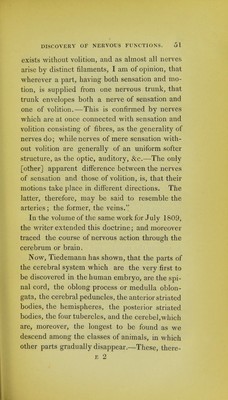
![exists without volition, and as almost all nerves arise by distinct filaments, I am of opinion, that wherever a part, having both sensation and mo- tion, is supplied from one nervous trunk, that trunk envelopes both a nerve of sensation and one of volition.—This is confirmed by nerves which are at once connected with sensation and volition consisting of fibres, as the generality of nerves do; while nerves of mere sensation with- out volition are generally of an uniform softer structure, as the optic, auditory, &c.—The only [other] apparent difference between the nerves of sensation and those of volition, is, that their motions take place in different directions. The latter, therefore, may be said to resemble the arteries; the former, the veins. In the volume of the same work for July 1809, the writer extended this doctrine; and moreover traced the course of nervous action through the cerebrum or brain. Now, Tiedemann has shown, that the parts of the cerebral system which are the very first to be discovered in the human embryo, are the spi- nal cord, the oblong process or medulla oblon- gata, the cerebral peduncles, the anterior striated bodies, the hemispheres, the posterior striated bodies, the four tubercles, and the cerebel,which are, moreover, the longest to be found as we descend among the classes of animals, in which other parts gradually disappear.—These, there- e 2](https://iiif.wellcomecollection.org/image/b21274010_0069.jp2/full/800%2C/0/default.jpg)




 No text description is available for this image
 No text description is available for this image
 No text description is available for this image