The nervous system, anatomical and physiological : in which the functions of the various parts of the brain are for the first time assigned: and to which is prefixed some account of the author's earliest discoveries, of which the more recent doctrine of Bell, Magendi, etc. is shown to be one.
- Alexander Walker
- Date:
- 1834
Licence: Public Domain Mark
Credit: The nervous system, anatomical and physiological : in which the functions of the various parts of the brain are for the first time assigned: and to which is prefixed some account of the author's earliest discoveries, of which the more recent doctrine of Bell, Magendi, etc. is shown to be one. Source: Wellcome Collection.
Provider: This material has been provided by UCL Library Services. The original may be consulted at UCL (University College London)
72/726 page 54
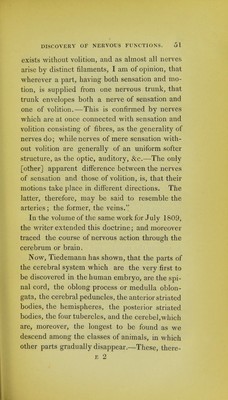
![which are, therefore, its ascending columns ; passes forward through the inferior fasciculi of the medulla oblongata [oblong process], and then through the crura cerebri [cerebral pedun- cles] ; extends forward, outward and upward through the corpora striata [anterior striated bo- dies] ; and reaches the hemispheres of the cere- brum itself. This is the course of its ascent to the sensorium commune. From the posterior part of the medulla [white matter] of the hemispheres, it returns by the tha- lami [posterior striated bodies], passing back- ward, inward and downward; flows backward in the fasciculi under the nates and testes [four tubercles] ; backward and upward through the processus cerebelli ad testes or anterior peduncles of cerebellum ; and thus reaches the medulla of the cerebellum itself.* From the cerebellum,! it descends through the posterior columns of the spinal marrow, * It is now worthy of remark, that other anatomists, in their unconnected and partial tracings of fibres, support the physiological view given in this paragraph, so far as the structure of the parts is concerned. — But this is the sub- ject of the work. t From that part, I may now observe, apparently return- ing fibres unite to form the posterior peduncles of the cere- bel, which become the restiform bodies on the posterior part of the oblong process, and the posterior columns of the spinal marrow.](https://iiif.wellcomecollection.org/image/b21274010_0072.jp2/full/800%2C/0/default.jpg)




 No text description is available for this image
 No text description is available for this image
 No text description is available for this image