The nervous system, anatomical and physiological : in which the functions of the various parts of the brain are for the first time assigned: and to which is prefixed some account of the author's earliest discoveries, of which the more recent doctrine of Bell, Magendi, etc. is shown to be one.
- Alexander Walker
- Date:
- 1834
Licence: Public Domain Mark
Credit: The nervous system, anatomical and physiological : in which the functions of the various parts of the brain are for the first time assigned: and to which is prefixed some account of the author's earliest discoveries, of which the more recent doctrine of Bell, Magendi, etc. is shown to be one. Source: Wellcome Collection.
Provider: This material has been provided by UCL Library Services. The original may be consulted at UCL (University College London)
87/726 page 69
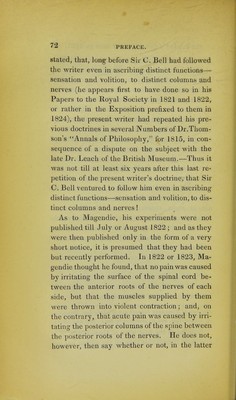
![of the blood, as the intellectual is more import- ant than the vascular system. The writer may now, by contrasting a few paragraphs, point out Some other striking Approximations, even in this first trifling work. In Archives of Science, Vol. II, for April 1809, page 179, the writer briefly but clearly said — Wherever a part, having both sensation and motion, is supplied from one nervous trunk, that trunk envelopes both a nerve of sen- sation and one of volition. In page 190, the writer says — As, in the inferior classes, the face advances, the cere- bellum uniformly recedes, and both are generally separated from the cerebrum either by membranes, or by bony plates. The present writer there says — Man has the greatest cere- brum, compared with his cere- bellum, and has likewise most of intellect, though not most of locomotion. Two years afterwards, Sir C. Bell, in page 6 of his pam- phlet, says— The view which I have to present, will ... do away the difficulty of conceiv- ing how sensation and volition should be the operation of the same nerve at the same mo- ment. Sir C. Bell, in page 18, says — The cerebrum, the ante- rior grand division, and the ce- rebellum, the posterior grand division, have slight and indi- rect connexion. Sir C. Bell, in page 20, says — In the latter [brutes], the cerebrum is much smaller* having nothing of the relative magnitude and importance which in man it bears to the other parts of the nervous sys- tem ; signifying that the cere- brum is the seat of those qua- lities of mind which distin- guish man.](https://iiif.wellcomecollection.org/image/b21274010_0087.jp2/full/800%2C/0/default.jpg)


 No text description is available for this image
 No text description is available for this image
 No text description is available for this image