A biographical, historical and chronological dictionary: containing accurate accounts of the lives, characters, and actions, of the most eminent persons of all ages and all countries; : including the revolutions of states, and the succession of sovereign princes / By John Watkins.
- John Watkins
- Date:
- 1807
Licence: Public Domain Mark
Credit: A biographical, historical and chronological dictionary: containing accurate accounts of the lives, characters, and actions, of the most eminent persons of all ages and all countries; : including the revolutions of states, and the succession of sovereign princes / By John Watkins. Source: Wellcome Collection.
106/976
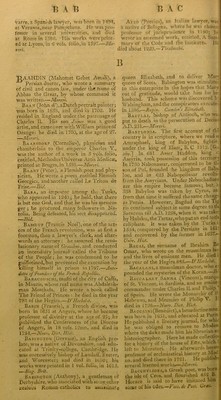
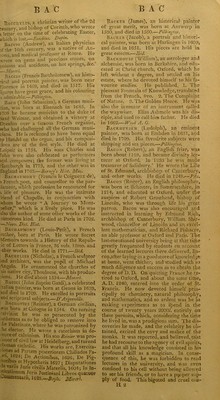
![varre, a Spanish lawyer, was born in I -I'M, A7./.0 (Pori ius), an Italian lawyer, vn - at Verasoa.near Pampeluna. He was pro- a native of Bologna, where he was chose;, lessor in several universities, and died professor of jurisprudence in 1190; L at Rome in 1586'. I lis works were print- wrote an esteemed work, entitled, A Surg- ed at Lyons, in (5 vols. folio,in 151)7.—Mo- mary of the Code and the institutes. He reri, died about 1220.— Tiraboicbi. b . i ; J2AAHDIN (Mahomet Gebet AmaK), a Persian doctor, who wrote a summary of civil and canon law, under the name of Abbas the Great, by whose command it was written.—Moreri. Baan (John d’),aDutch portrait painter; was born in 1638, and died in 1702. He resided in England under the patronage of Charles II. His son James was a good artist, and came over with William prince of Orange: he died in 1700, at the age of 27. —Moreri. Baarsdotu* (Cornelius), physician and chamberlain to the emperor Charles V., was the author of a work in 5 vols. folio, entitled, MethodusUniversse Artis Medicas, printed at Bruges, in 1538.—Moreri. Baart (Peter), a Blemish poet and phy- sician. He wrote a poem entitled Flemish Georgies, and another called Le Triton de Prise.—Ibid. Baba, an impostor among the Turks, who appeared in 1240 ; he held, that there is but one God, and that he was his messen- ger ; he procured many followers in Na- toiia. Being defeated, his sect disappeared. —Ibid. Babceuf (Francis Noel), one of the act- ors of the French revolution, was at first a footman, then a lawyer’s clerk, and after- wards an attorney: he assumed the revo- lutionary name of Gracchus, and conducted an incendiary journal called the Tribune of the People ; he was condemned to be guillotined, but prevented the execution by killing himself in prison in 1797.—Anec- dotes of Founders of the French Republic. Babacouscui, mufti of the city of CafFi, in Mauris, whose real name was Abdalrah- man Mosthafa. He wrote a book called The Friend of Princes : he died in the year 783 of the Hegira.—D' Her helot. Babin (Francis), a French divine, was born in 1651 at Angers, where he became professor of divinity at the age of 25; he published the Conferences of the Diocese of Angers, in 18 vols. 12mo. and died in 1734.—Nowv. Dirt. Hist. Babington (Gervase), an English pre- late, was a native of Devonshire, and edu- cated at Trinity-college, Cambridge. I Ie .was successively bishop of Lauda IF, Exeter, and Worcester; and died in 1610; his works were printed in 1 vol. folio, in 1615. —Biog. Brit. Babington (Anthony), a gentleman of Derbyshire, who associated with some other zealous Roman catholics to assassinate queen Elizabeth, and to deliver Mar queen of Scots. Babington was stimulate to this enter prize in the hopes that Mary out of gratitude, would take him lor he: husband. This scheme was discovered b Walsingham, and the conspirators execute, in 1586.—Rupin. Camden s Elizabeth. Babylas, bishop of Antioch, who wa put to death in the persecution of Deem; A.D. 251.—Moreri. Babylonia. The first account of tbr country is in scripture, where we read u Amraphael, king of Babylon, fightin under the king of Elam, B. C 191.3- [G.-. xiv. ] In 681 Asser Haddon, king q Assyria, took possession of this territory In 1730 Nabonassar, conjectured to be thi son of Pul, founded he kingdom of Baby Ion, and in 625 Nabopollasar revoke from the Assyrians. Under Nebuchadne;* zer this empire became famous; but 1 538 Babylon was taken by Cyrus, an from that time it suffered the same chang'. as Persia. However, Bagdad on the Tig ris continued subject in some degree to tb Saracens tiil A.D. 1258, when it was take by Hulaku, the Tartar, who putan end toth caliphate. It was taken by the J urks i 1534, conquered by the Persians in 161: and recovered by the former in 1637.- Unin. Hist. _ • Bacai, the surname of Ibrahim Be Omar, who wrote on the mussv.lman la’, and the lives of eminent men. He died 1 the year of the Hegira 885.—D'Herlelot. Bacalani, a mussulman doctor, who e: pounded tl>e mysteries of the Koran.—lb Bagcalary Sanna (Vincent), marquj of St. Vincent, in Sardinia, and an emine commander under Charles II. and Philip of Spain. He wrote the Monarchy of tl Hebrews, and Memoirs of Philip V. K died in 1726.—Now. Diet. Hist. Ba cc at n I (Benedict), a beuedicti ne mon was born in 1651, and educated at Parin He published a literary journal, for whiCj he was obliged to remove to Moden where the duke made him his librarian at historiographer. Here he made collectioi for a history of the house of Este, which 1 left to Muratori. He afterwards becan professor of ecclesiastical history at Moo 11a,and died there in 1721. Republish; several learned works*—Moreri. BACCHVLiDEs.a Greek poet, was born the isle of Ceos, and flourished 452 B. Horace is said to hare imitated him some of his odes.—Foss, de Poet. Grac.](https://iiif.wellcomecollection.org/image/b28742801_0106.jp2/full/800%2C/0/default.jpg)



 No text description is available for this image
 No text description is available for this image
 No text description is available for this image