The natural history of the Bible ; or, A description of all the quadrupeds, birds, fishes, reptiles, and insects, trees, plants, flowers, gums, and precious stones, mentioned in the sacred scriptures: Collected from the best authorities, and alphabetically arranged / by Thaddeus Mason Harris.
- Thaddeus Mason Harris
- Date:
- 1824
Licence: Public Domain Mark
Credit: The natural history of the Bible ; or, A description of all the quadrupeds, birds, fishes, reptiles, and insects, trees, plants, flowers, gums, and precious stones, mentioned in the sacred scriptures: Collected from the best authorities, and alphabetically arranged / by Thaddeus Mason Harris. Source: Wellcome Collection.
140/474 page 100
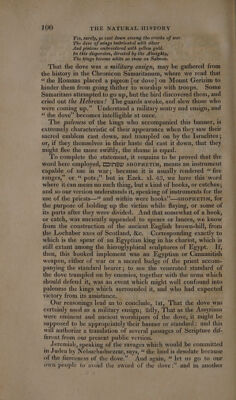
![Yes, surely, ye cast down among the crooks of war The dove of wings imbricated with silver And pinions embroidered with yellow gold. In this dispersion, directed by the Almighty, - The kings became white as snow on Salmon. That the dove was a military ensign, may be gathered from - the history in the Chronicon Samaritanum, where we read that * the Romans placed a pigeon [or dove] on Mount Gerizim to hinder them from going thither to worship with troops. Some Samaritans attempted to go up, but the bird discovered them, and cried out the Hebrews! 'The guards awoke, and slew those who were coming up.” Understand a military sentry and ensign, and * the dove” becomes intelligible at once. The paleness of the kings who accompanied this banner, 1s extremely characteristic of their appearance when they saw their sacred emblem cast down, and trampled on by the Israelites ; or, if they themselves in their haste did cast it down, that they might flee the more swiftly, the shame is equal. To complete the statement, it remains to be proved that the word here employed, t'nBw sHOPHETIM, means an instrument capable of use in war; because it is usually rendered “ fire ranges, or “ pots; but in Ezek. xl. 43, we have this word where it can mean no such thing, but a kind of hooks, or catches; and so our version understands it, speaking of instruments for the use of the priests— and within were hooks—snoPnETi1M, for the purpose of holding up the victim while flaying, or some of its parts after they were divided. And that somewhat of a hook, or catch, was anciently appended to spears or lances, we know from the construction of the ancient English brown-bill, from the Lochaber axes of Scotland, &c. Corresponding exactly to which is the spear of an Egyptian king in his chariot, which is still extant among the hieroglyphical sculptures of Egypt. 1f, then, this hooked implement was an Egyptian or Canaanitish weapon, either of war or a sacred badge of the priest accom- panying the standard bearer; to see the venerated standard of the dove trampled on by enemies, together with the arms which should defend it, was an event which might well confound into paleness the kings which surrounded it, and who had expected victory from its assistance. Our reasonings lead us to conclude, 1st, That the dove was certainly used as a military ensign; 2dly, That as the Assyrians | were eminent and ancient worshipers of the dove, it might be supposed to be appropriately their banner or standard: and this will authorize a translation of several passages of Scripture dif- ferent from our present public version. . Jeremiah, speaking of the ravages which would be committed in Judea by Nebuchadnezzar, says, “ the land is desolate because of the fierceness of the dove. And again, * let us go to our own people to avoid the sword of the dove: and in another](https://iiif.wellcomecollection.org/image/b33290684_0140.jp2/full/800%2C/0/default.jpg)



 No text description is available for this image
 No text description is available for this image
 No text description is available for this image