A descriptive catalogue of the historical manuscripts in the Arabic and Persian languages, preserved in the library of the Royal Asiatic Society of Great Britain and Ireland.
- William Hook Morley
- Date:
- 1854
Licence: Public Domain Mark
Credit: A descriptive catalogue of the historical manuscripts in the Arabic and Persian languages, preserved in the library of the Royal Asiatic Society of Great Britain and Ireland. Source: Wellcome Collection.
124/178 (page 110)
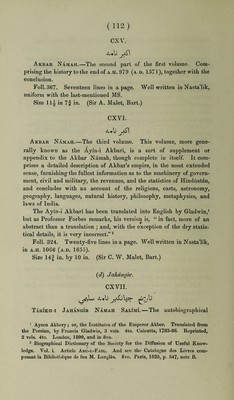
![The present MS. comprises the first two volumes of the Akbar Namah. Vol. I.—Divided into two parts, and a conclusion. Part 1. Containing the author’s preface ; an account of Akbar’s birth, and of his ancestors ; of the Mongols, from their origin ; and of Timur, Babar, and Humayun, giving a detailed history of the reign of the last-named emperor, to his death in a.u 963 (a.d. 155.5}. Part 2. The history of the reign of the Emperor Akbar, from his accession to the throne, to the second of Jumada al-Awwal, a.ii. 979 (a.d. 1571).' Conclusion.—Many MSS. omit this conclusion,^ and it seems doubtful whether it is from the pen of the author. Vol. II.—The continuation of the history of Akbar to Ramazan A.H. 1010 (a.d. 1601), the commencement of the forty-eighth year of his reign. I cannot refrain from quoting in this place Mr. Elphinstone’s excellent criticism on the Akbar Namah :—“ Abul Fazl, in this reign, shows all his usual merits, and more than his usual defects. Every event that had a tendency to take from the goodness, wisdom, or power of Akbar, is passed over or misstated j and a uniform strain of panegyric and triumph is kept up, which disgusts the reader with the author, and almost with the hero. Amidst these unmeaning flourishes, the real merits of Akbar disappear, and it is from other authors that we learn the motives of his actions, the difflculties he had to contend with, and the resources by which they were surmounted. The gross flattery of a book written by one so well acquainted with Akbar’s disposition, and submitted, it appears, to his own inspection, leaves an impression of the vanity of that prince, which is almost the only blot on his admirable character.” ® Foil. 232. Thirty-two lines in a page. Well written inShikastah, in A.H. 1145-46 (a.d. 1732-33). Size ]6f in. by 9^ in. (Major D. Price.) ‘ In seme MSS. this second part of the first volume continues the history to the end of .a.h. 979 (a.d. 1571). See infra, Nos. CX., CXI., CXV. In others the second-part ends as in the text, and the remainder is found at the commencement of the second volume. * Exemp. gr. see infra. Nos. CX., CXI. ® Elpliinstone, Hist, of India, vol. ii. p. 308, note, 2nd edit.](https://iiif.wellcomecollection.org/image/b30092929_0124.jp2/full/800%2C/0/default.jpg)