The miscellany of the Irish Archæological Society. Vol. I.
- Irish Archaeological Society
- Date:
- MDCCCXLVI. [1846]
Licence: Public Domain Mark
Credit: The miscellany of the Irish Archæological Society. Vol. I. Source: Wellcome Collection.
25/322 page 13
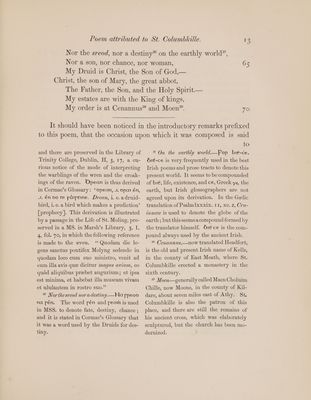
![x 65 790 and there are preserved in the Library of Trinity College, Dublin, H, 3, 17, a cu- rious notice of the mode of interpreting the warblings of the wren and the croak- ings of the raven. Opean is thus derived in Cormac’s Glossary: ‘opean, .i. onai én, 1. én oo ni péipeine. Drean, i. e. a druid- bird, i. e. a bird which makes a prediction’ [ prophecy]. This derivation is illustrated by a passage in the Life of St. Moling, pre- served in a MS. in Marsh’s Library, 3, 1, 4, fol. 70, in which the following reference is made to the wren. “ Quodam die le- quodam loco cum suo ministro, venit ad eum illa avis que dicitur magus avium, eo quód aliquibus prebet augurium; et ipsa est minima, et habebat illa muscam vivam et ululantem in rostro suo. ** Nor the sreod nor adestiny.—Na ppeoo na pén. The word pén and peom is used in MSS. to denote fate, destiny, chance ; . and it is stated in Cormac’s Glossary that it was a word used by the Druids for des- tiny. to 7 On the earthly world.Fop bié-ce. Óic-ce is very frequently used in the best Irish poems and prose tracts to denote this present world. It seems to be compounded of bie, life, existence, and ce, Greek yz, the earth, but Irish glossographers are not agreed upon its derivation. In the Gaelic translation of Psalmlxxxix. 11, xoc. 2, Cru- innece is used to denote the globe ofthe earth; but this seems a compound formed by the translator himself. Oiéce is the com- pound always used by the ancient Irish. 38 Cenannus, —now translated Headfort, is the old and present Irish name of Kells, in the county of East Meath, where St. Columbkille erected a monastery in the sixth century. 399 Moen—generally called Maen Choluim Chille, now Moone, in the county of Kil- dare, about seven miles east of Athy. St. Columbkille is also the patron of this place, and there are still the remains of his ancient cross, which was elaborately sculptured, but the church has been mo- dernized.](https://iiif.wellcomecollection.org/image/b28754281_0025.jp2/full/800%2C/0/default.jpg)
 No text description is available for this image
 No text description is available for this image
 No text description is available for this image