Investigations on the purification of Boston sewage made at the sanitary research laboratory and sewage experiment station of the Massachusetts institute of technology, with a history of the sewage-disposal problem / By C.E.A. Winslow and Earle B. Phelps.
- Charles-Edward Amory Winslow
- Date:
- 1906
Licence: In copyright
Credit: Investigations on the purification of Boston sewage made at the sanitary research laboratory and sewage experiment station of the Massachusetts institute of technology, with a history of the sewage-disposal problem / By C.E.A. Winslow and Earle B. Phelps. Source: Wellcome Collection.
Provider: This material has been provided by London School of Hygiene & Tropical Medicine Library & Archives Service. The original may be consulted at London School of Hygiene & Tropical Medicine Library & Archives Service.
148/176 page 142
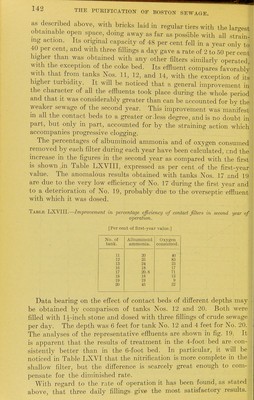
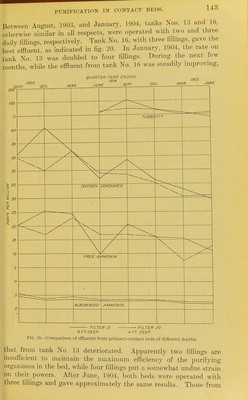
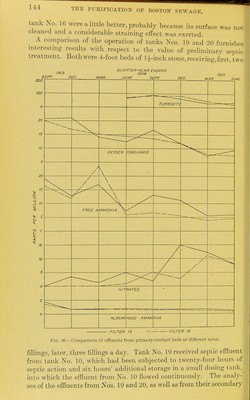
![as described above, with bricks laid in regular tiers with the largest obtainable open space, doing away as far as possible with aU strain- ing action. Its original capacity of 48 per cent fell in a year only to 40 per cent, and with tliree fallings a day gave a rate of 2 to 50 per cent liigher than was obtained with any other fUters simUarly operated with the exception of the coke bed. Its effluent compares favorably with that from tanks Nos. 11, 12, and 14, with the exception of its higher turbidity. It wiU be noticed that a general improvement in the character of aH the effluents took place during the whole period and that it was considerably greater than can be accounted for by the weaker sewage of the second year. This improvement was manifest in all the contact beds to a greater or.less degree, and is no doubt m part, but only in part, accounted for by the straining action which accompanies progressive clogging. The percentages of albuminoid ammonia and of oxygen consumed removed by each fflter during each year have been calculated, end the increase in the figures in the second year as compared with the first is shown in Table LXVIII, expressed as per cent of the first-j^ear yaliie. The anomalous results obtained with tanks Nos. 17 and 19 are due to the very low efflciency of No. 17 during the first year and to a deterioration of No. 19, probably due to the overseptic effluent with which it was dosed. Table LXVIII.—Improvement in percentage efficiency of contact filters in second year of operation. [Per cent of flrst-year value.] No. of Albuminoid Oxygen tank. ammonia. consumed. 11 20 40 12 25 83 13 24 23 16 18 17 17 20.8 71 18 18 13 19 19 9 20 45 32 Data bearing on the effect of contact beds of different depths may be obtained by comparison of tanks Nos. 12 and 20. Both were fflled with 1^-inch stone and dosed with three fillings of crude sewage per day. The depth was 6 feet for tank No. 12 and 4 feet for No. 20. The analyses of the representative effluents are sho^^^l in fig. 19. It is apparent that the results of treatment in the 4-foot bed are con- sistently better than in the 6-foot bed. In particular, it will be noticed in Table LXVI that the nitrification is more complete in the shallow filter, but the difference is scarcely great enough to com- pensate for the diminished rate. With regard to the rate of operation it has been found, as stated above, that three daily ffllmgs give the most satisfactory results.](https://iiif.wellcomecollection.org/image/b21358205_0148.jp2/full/800%2C/0/default.jpg)