Investigations on the purification of Boston sewage made at the sanitary research laboratory and sewage experiment station of the Massachusetts institute of technology, with a history of the sewage-disposal problem / By C.E.A. Winslow and Earle B. Phelps.
- Charles-Edward Amory Winslow
- Date:
- 1906
Licence: In copyright
Credit: Investigations on the purification of Boston sewage made at the sanitary research laboratory and sewage experiment station of the Massachusetts institute of technology, with a history of the sewage-disposal problem / By C.E.A. Winslow and Earle B. Phelps. Source: Wellcome Collection.
Provider: This material has been provided by London School of Hygiene & Tropical Medicine Library & Archives Service. The original may be consulted at London School of Hygiene & Tropical Medicine Library & Archives Service.
25/176 page 19
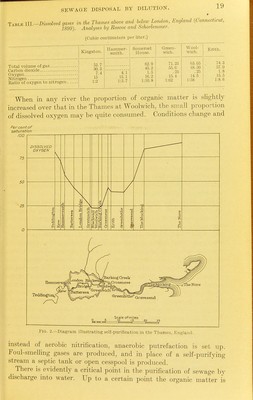
![TvBLE III -Dissolved oases in the Thames above and Mow London, Emjland {Connecticut, 1S90). Analyses hy Roscoe and Srhoriemmcr. [Cubic centimeters per liter.] Kingston. Ilammer- smitti. Somerset House. Green- wieli. vv OOl- ■wich. Eritll. Ratio of o.xygen to nitrogen 52.7 30.3 7.4 15 1:2 4.1 15.1 1:3.7 62.9 45.2 1.5 16.2 1:10.8 71.25 55.6 .25 1.5.4 1:62 (i3.05 48.30 .25 14.5 1:58 74.3 57.0 1.8 15.5 1:8.6 When in any river the proportion of organic matter is slightly increased over that in the Thames at Woolwich^ the small proportion of dissolved oxygen may be quite consumed Conditions change and Fig. 2.—Diagram illustrating self-purification in tiie Thames, England. instead of aerobic nitrification, anaerobic putrefaction is set up. Foul-smelling gases are produced, and in place of a self-purifying stream a septic tank or open cesspool is produced. There is evidently a critical point in the purification of sewage by discharge into water. Up to a certain point the organic matter is](https://iiif.wellcomecollection.org/image/b21358205_0025.jp2/full/800%2C/0/default.jpg)