Investigations on the purification of Boston sewage made at the sanitary research laboratory and sewage experiment station of the Massachusetts institute of technology, with a history of the sewage-disposal problem / By C.E.A. Winslow and Earle B. Phelps.
- Charles-Edward Amory Winslow
- Date:
- 1906
Licence: In copyright
Credit: Investigations on the purification of Boston sewage made at the sanitary research laboratory and sewage experiment station of the Massachusetts institute of technology, with a history of the sewage-disposal problem / By C.E.A. Winslow and Earle B. Phelps. Source: Wellcome Collection.
Provider: This material has been provided by London School of Hygiene & Tropical Medicine Library & Archives Service. The original may be consulted at London School of Hygiene & Tropical Medicine Library & Archives Service.
47/176 page 41
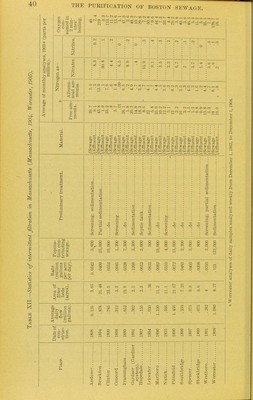
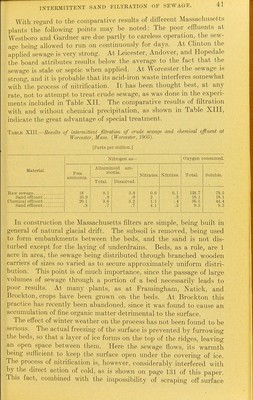
![With regard to the comparative results of different Massachusetts plants the following points may be noted: The poor effluents at Westboro and Gardner are due partly to careless operation,^ the sew- age being allowed to run on continuously for days. At Clinton the applied sewage is very strong. At Leicester, Andover, and Hopedale the board attributes results below the average to the fact that the sewage is stale or septic when applied. At Worcester the sewage is strong, and it is probable that its acid-iron waste interferes somewhat with the process of nitrification. It has been thought best, at any rate, not to attempt to treat crude sewage, as was done in the experi- ments included in Table XII. The comparative results of filtration with and without chemical precipitation, as shown in Table XIII, indicate the great advantage of special treatment. Table XLU—Resiilis of intermittent filtration of crude sewage and chemical effluent at Worcester, Mass. {Worcester, 1905). [Parts per million.] Material. Nitrogen as— Oxygen consumed. Free ammonia. Albuminoid am- monia. Nitrates. Nitrites. Total. Soluble. Total. Dissolved. Raw sewage 18 8.1 3.8 0.6 0.1 138.7 79.5 Sand effluent 10.9 .9 .9 2 .3 18.1 18.1 Chemical effluent 20.1 3.6 3.2 1.1 .4 56.5 44.4 .8 .7 .7 4.1 .2 9.5 9.5 In construction the Massachusetts filters are simple, being built in general of natural glacial drift. The subsoil is removed, being used to form embanlonents between the beds, and the sand is not dis- turbed except for the laying of underdrains. Beds, as a rule, are 1 acre in area, the sewage being distributed tlirough branched wooden carriers of sizes so varied as to secure approximately uniform distri- bution. This point is of much importance, since the passage of large volumes of sewage through a portion of a bed necessarily leads to poor results. At many plants, as at Framingham, Natick, and Brockton, crops have been grown on the beds. At Brockton this practice has recently been abandoned, since it was found to cause an accumulation of fine organic matter detrimental to the surface. The effect of winter weather on the process has not been found to be serious. The actual freezing of the surface is prevented by furrowing the beds, so that a layer of ice forms on the top of the ridges, leaving an open space between them. Here the sewage flows, its warmth being sufficient to keep the surface open under the covering of ice. The process of nitrification is, however, considerably interfered with by the direct action of cold, as is shown on page 131 of tliis paper. This fact, combmed with the impossibihty of scraping off surface](https://iiif.wellcomecollection.org/image/b21358205_0047.jp2/full/800%2C/0/default.jpg)