Case of successful ligature of common iliac artery / by W. B. McKinlay.
- McKinlay, Walter Boyd.
- Date:
- 1864
Licence: Public Domain Mark
Credit: Case of successful ligature of common iliac artery / by W. B. McKinlay. Source: Wellcome Collection.
Provider: This material has been provided by The University of Glasgow Library. The original may be consulted at The University of Glasgow Library.
3/8
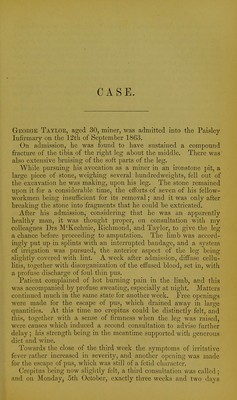
![CASE. George Taylor, aged 30, miner, was admitted into the Paisley- Infirmary on the 12th of September 1863. On admission, he was found to have sustained a compound fi-acture of the tibia of the right leg about the middle. There was also extensive bruising of the soft parts of the leg. While pm-suing his avocation as a miner in an ironstone pit, a large piece of stone, weighing several hundredweights, fell out of the excavation he was making, upon his leg. The stone remained upon it for a considerable time, the efforts of seven of his fellow- workmen being insufficient for its removal; and it was only after breaking the stone into fragments that he could be extricated. After his admission, consideiing that he was an apparently healthy man, it was thought proper, on consultation with my colleagues Drs M'Kechnie, Richmond, and Taylor, to give the leg a chance before proceeding to amputation. The limb was accord- ingly put up in splints with an interrupted bandage, and a system of irrigation was pursued, the anterior aspect of the leg being slightly covered with lint. A week after admission, diffuse cellu- litis, together with disorganization of the effused blood, set in, with a profuse discharge of foul thin pus. Patient complained of hot burning pain in the limb, and this was accompanied by profuse sweating, especially at night. ]\Iatters continued much in the same state for another week. Free openings were made for the escape of pus, which drained away in large quantities. At this time no crepitus could be distinctly felt, and this, together with a sense of firmness when the leg was raised, were causes which induced a second consultation to advise further delay ; his strength being in the meantime supported with generous diet and wine. Towards the close of the third week the symptoms of irritative fever rather increased in severity, and another opening was made for the escape of pus, which was still of a fetid character. Crepitus being now slightly felt, a third consultation was called; and on Monday, 5th October, exactly three weeks and two days](https://iiif.wellcomecollection.org/image/b21477425_0003.jp2/full/800%2C/0/default.jpg)