The elements of optics: designed for the use of students in the university / James Wood.
- James Wood
- Date:
- 1811
Licence: Public Domain Mark
Credit: The elements of optics: designed for the use of students in the university / James Wood. Source: Wellcome Collection.
237/262 (page 229)
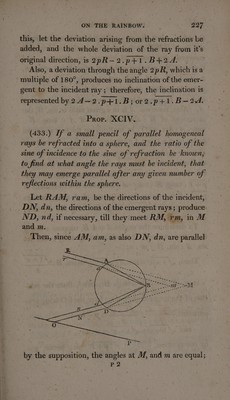
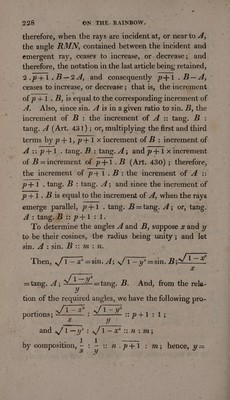
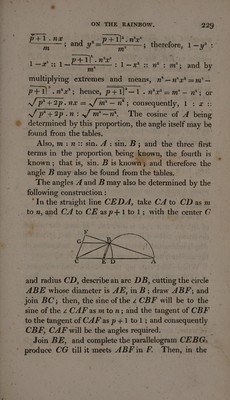
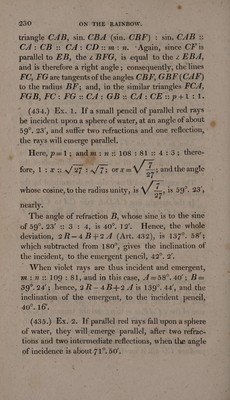
![pt+l.na +1)? . 2x itis “a 1p Spee and y? ti Ma therefore, at i +1] .n*2 Lats pat TS ete 7 ae pee mae a: nm : m'; and by | multiplying extremes and means, n*—n?x* =m’ — p+i\ .n*x’; hence, grit Vx =m — n*; or J p+ 2p.ne = f/m — n*; consequently, 1: x :: / p+2p.n:/m—n. The cosine of 4 being determined by this proportion, the angle itself may be found from the tables. Also, m:n.:: sin. 4: sin. B; and the three first terms in the proportion. being known, the fourth is known; that is, sin. B is known; and therefore the angle B may also be found from the tables. The angles A and B may also be determined by the following construction : “In the straight line CE DA, take CA to-CDias m to n, and CA to CE asp+1to1; with the center C cS eas EN Cc E D A and radius CD, describe an arc DB, cutting the circle ABE whose diameter is 4E, in B; draw ABF; and join BC; then, the sine of the z CBF will be to the sine of the z CAF as m to n; and the tangent of CBF to the tangent of CAF as p +1 to 13 and consequently CBF, CAF will be the angles required. ~ Join BE, and complete the parallelogram CEB Gy ‘produce CG till it meets 4BF' in F. Then, in the](https://iiif.wellcomecollection.org/image/b33089541_0237.jp2/full/800%2C/0/default.jpg)