French cookery for ladies / by A cordon bleu (Madame Emilie Lebour-Fawsett).
- Lebour-Fawsett, Emilie, Madame.
- Date:
- 1890
Licence: Public Domain Mark
Credit: French cookery for ladies / by A cordon bleu (Madame Emilie Lebour-Fawsett). Source: Wellcome Collection.
Provider: This material has been provided by The University of Leeds Library. The original may be consulted at The University of Leeds Library.
131/520 page 111
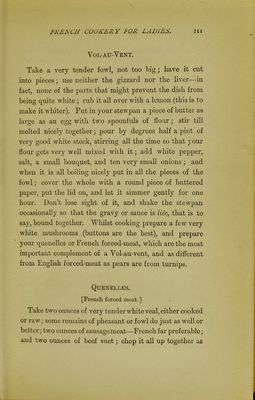
![Vol-au-Vent. Take a very tender fowl, not too big; have it cut into pieces; use neither the gizzard nor the liver—in fact, none of the parts that might prevent the dish from being quite white ; rub it all over with a lemon (this is to make it whiter). Put in your stewpan a piece of butter as large as an egg with two spoonfuls of flour; stir till melted nicely together; pour by degrees half a pint of very good white stock, stirring all the time so that your flour gets very well mixed with it; add white pepper, salt, a small bouquet, and ten very small onions ; and when it is all boiling nicely put in all the pieces of the fowl; cover the whole with a round piece of buttered paper, put the lid on, and let it simmer gently for one hour. Don’t lose sight of it, and shake the stewpan occasionally so that the gravy or sauce is IMe, that is to say, bound together. Whilst cooking prepare a few very white mushrooms (buttons are the best), and prepare your quenelles or French forced-meat, which are the most important complement of a Yol-au-vent, and as different from English forced-meat as pears are from turnips. Quenelles. [French forced meat.] Take two ounces of very tender white veal, either cooked or raw; some remains of pheasant or fowl do just as well or better; two ounces of sausage meat—French far preferable; and two ounces of beef suet; chop it all up together as](https://iiif.wellcomecollection.org/image/b21524671_0131.jp2/full/800%2C/0/default.jpg)