An anatomical disquisition on the motion of the heart & blood in animals / by William Harvey ; translated from the Latin by Robert Willis.
- William Harvey
- Date:
- [1906]
Licence: In copyright
Credit: An anatomical disquisition on the motion of the heart & blood in animals / by William Harvey ; translated from the Latin by Robert Willis. Source: Wellcome Collection.
Provider: This material has been provided by The University of Leeds Library. The original may be consulted at The University of Leeds Library.
74/280 page 38
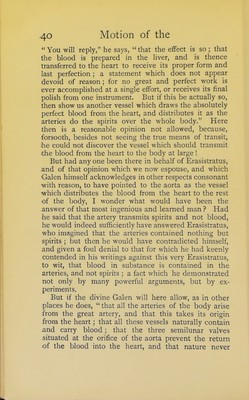
![trigger being touched, down comes the flint, strikes against the steel, elicits a spark, which falling among the powder, it is ignited, upon which the flame extends, enters the barrel, causes the explosion, propels the ball, and the mark is attained—all of which incidents, by reason of the celerity with which they happen, seem to take place in the twinkling of an eye. So also in deglutition : by the elevation of the root of the tongue, and the compression of the mouth, the food or drink is pushed into the fauces, the larynx is closed by its own muscles, and the epiglottis, whilst the pharynx, raised and opened by its muscles no otherwise than is a sac that is to be filled, is lifted up, and its mouth dilated; upon which, the mouthful being received, it is forced downwards by the transverse muscles, and then carried farther by the longitudinal ones. Yet are all these motions, though executed by different and distinct organs, performed harmoniously, and in such order, that they seem to constitute but a single motion and act, which we call deglutition. Even so does it come to pass with the motions and action of the heart, which constitute a kind of deglu- tition, a transfusion of the blood from the veins to the arteries. And if any one, bearing these things in mind, will carefully watch the motions of the heart in the body of a living animal, he will perceive not only all the particulars I have mentioned, viz. the heart be- coming erect, and making one continuous motion with its auricles; but farther, a certain obscure undulation and lateral inclination in the direction of the axis of the right ventricle, [the organ] twisting itself slightly in performing its work. And indeed every one may see, when a horse drinks, that the water is drawn in and transmitted to the stomach at each movement of the throat, the motion being accompanied with a sound, and yielding a pulse both to the ear and the touch; in the same way it is with each motion of the heart, when there is the delivery of a quantity](https://iiif.wellcomecollection.org/image/b21536326_0074.jp2/full/800%2C/0/default.jpg)




 No text description is available for this image
 No text description is available for this image
 No text description is available for this image