An anatomical disquisition on the motion of the heart & blood in animals / by William Harvey ; translated from the Latin by Robert Willis.
- William Harvey
- Date:
- [1906]
Licence: In copyright
Credit: An anatomical disquisition on the motion of the heart & blood in animals / by William Harvey ; translated from the Latin by Robert Willis. Source: Wellcome Collection.
Provider: This material has been provided by The University of Leeds Library. The original may be consulted at The University of Leeds Library.
75/280 page 39
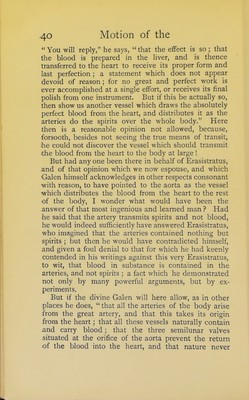
![of blood from the veins to the arteries, that a pulse takes place, and can be heard within the chest. The motion of the heart, then, is entirely of this description, and the one action of the heart is the transmission of the blood and its distribution, by means of the arteries, to the very extremities of the body; so that the pulse which we feel in the arteries is nothing more than the impulse of the blood derived from the heart. Whether or not the heart, besides propelling the blood, giving it motion locally, and distributing it to the body, adds anything else to it,—heat, spirit, per- fection,—must be inquired into by and by, and decided upon other grounds. So much may suffice at this time, when it is shown that by the action of the heart the blood is transfused through the ventricles from the veins to the arteries, and distributed by them to all parts of the body. So much, indeed, is admitted by all [physiologists], both from the structure of the heart and the arrange- ment and action of its valves. But still they are like persons purblind or groping about in the dark ; and then they give utterence to diverse, contradictory, and incoherent sentiments, delivering many things upon conjecture, as we have already had occasion to remark. The grand cause of hesitation and error in this subject appears to me to have been the intimate con- nection between the heart and the lungs. When men saw both the vena arteriosa [or pulmonary artery] and the arteriae venosae [or pulmonary veins] losing them- selves in the lungs, of course it became a puzzle to them to know how or by what means the right ventricle should distribute the blood to the body, or the left draw it from the venae cavae. This fact is born witness to by Galen, whose words, when writing against Erasistratus in regard to the origin and use of the veins and the coction of the blood, are the following : 1 ' De Placitis Hippocratis et Platonis, vi.](https://iiif.wellcomecollection.org/image/b21536326_0075.jp2/full/800%2C/0/default.jpg)




 No text description is available for this image
 No text description is available for this image
 No text description is available for this image