Observations and experiments on the use of opium, bromide of potassium, and cannabis indica in insanity, especially in regard to the effects of the two latter given separately / by T. S. Clouston, M.D.
- Thomas Clouston
- Date:
- [1871], [©1871]
Licence: Public Domain Mark
Credit: Observations and experiments on the use of opium, bromide of potassium, and cannabis indica in insanity, especially in regard to the effects of the two latter given separately / by T. S. Clouston, M.D. Source: Wellcome Collection.
Provider: This material has been provided by The University of Glasgow Library. The original may be consulted at The University of Glasgow Library.
14/42 (page 12)
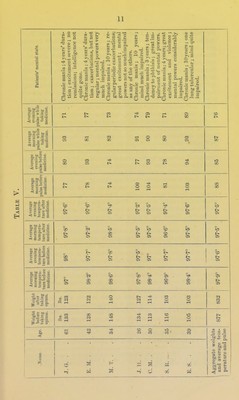
![five minims three times a day, for the next two weeks one fluid drachm three times a day, for the next eight weeks one fluid drachm and a half three times a day.^ Of course the patients during all this time were in the same circumstances with regard to diet, clothing, and other conditions. Tlie reason I kept up the drachm and a half doses so long was, that this is about the limit of the doses commonly used in mania, and I wished to ascertain the eff'ects of such ordinarily employed doses. At the end of the twelve weeks the medicine was stopped. Of the nine I found that the opium caused such persistent sickness and total absence of appetite in two, that I could not continue it for more than a few days. There were only seven, therefore, in whom the experiment was continued to the end. Excitement.—As regards the maniacal excitement, I found that in none of the cases did the twenty-five minim doses subdue it in any degree, and during the fortnight they took this dose there was on perceptible change in their a])petites, weights, temperatures, or pulses. During the fortnight they took drachm doses there was a very perceptible difference in the maniacal excitement in all of them but one, who at the time was passing through one of the regular ex- acerbations which characterised her case. In three of them there was a decided tendency to drowsiness through the day. In one case the partial subsidence of the excitement which characterised the first week did not last through the second, for by the end of it she was about as excited as ever. Five of them had begun to lose in weight, though the absolute loss was small, bemg only eleven pounds in the five. There was a slight fall in the temperatures of most of them. When the dose was raised to a drachm and a half the excitement was very markedly lessened or altogether overcome in all of them. This eff'ect was not lasting, however, in all the cases, for by the end of six weeks two of them were nearly as excited as ever, and the one who was subject to exacerbations had one of these during this period, and was ahnost as bad as when she was free from the influence of any drug. The most careful examination into the character of the cases did not show any reasons why one case should have been more and longer affected by the opium tliau another. To refer to Table Y, J. G. and C. M. became almost as bad as ever when taking the medicine, and M. T., during one of the exacerbations of her malady, was but little affected by it. One of these patients was old, the other two young. In one case the mental powers were very much affected, in the other two not so much so. Two of them were robust, trie third had a tendency to phthisis. The results ofthe treatment in all of them are shown in Table Y. 1 They got the first dose of the opium at seven o'clock in the morning, and the temperatures werie taken at half-past ten. I wished to avoid the immediate effects of a dose of the drug.](https://iiif.wellcomecollection.org/image/b21481428_0014.jp2/full/800%2C/0/default.jpg)