Tenth annual report of the Columbia Institution for the Deaf and Dumb, for the year ending June 30, 1867.
- Columbia Institution for the Deaf and Dumb (Washington, D.C.)
- Date:
- 1867
Licence: Public Domain Mark
Credit: Tenth annual report of the Columbia Institution for the Deaf and Dumb, for the year ending June 30, 1867. Source: Wellcome Collection.
Provider: This material has been provided by The Royal College of Surgeons of England. The original may be consulted at The Royal College of Surgeons of England.
27/64 page 25
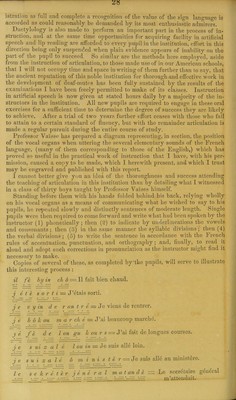
![ZD profession he admitted that not all deaf-mutes succeeded in acquiring the power of articulation, assigning as a reason therefor that some did not seem to possess sufficifut ])ower over the muscles of the vocal organs. He instanced the case of the pupil referred to above, whose reading 1 was unable to understand, and said that his father, a speaking and hearing man, had a very grutf, muffled voice, not easily understood even in ordinary conversation, rendering it probable that the son inherited some disability of the organs of utterance. Mr. Schibel acknowledged the necessity of a considerable use of signs in the earlier years of instruction, but said he gave religious instruction only with the voice, the younger pupils not being able to participate in this exercise. THE INSTITUTION AT ROTTERDAM, HOLLAND. An address on the subject of deaf-mute instruction, delivered before the “ ninth congress (scientific) of the Netherlands,” in Ghent, last August, by Mr. Hirsch, the director of the Kotterdam school, so clearly defines his position as a radical supporter of the artificial method that I will quote a few pai-agraphs from it before proceeding to describe my visit to him and his establishment: “ The first and principal fact that has been made patent to society is the pos- sibility of developing intellectually, morally, and religiously the deaf and dumb. As to the means by the aid of which instruction can and ought to be imparted to them, opinions are very diverse, often very contradictory. Those diversities and contradictions of opinion have given rise to differences in methods of in- struction and to dissensions between the schools of Franpe and of Germany. “ The object to be attained is to render possible the admission of the deaf- mute into society by teaching him to see—that is, to understand—the movements of the lips and to speak in his turn. “ To attain this end the act of seeing or comprehending and of speaking must be the exclusive principle of instruction, and neither the palpable alphabet nor the language of signs can have any connexion with it. “ It is true that the language of natural signs is the fii’st means employed by the teacher to enter into relations with the pupil, but he does not make use of this method for any length of time, and it is abandoned as soon as it can be superseded by speech. “The daily observations which I have made for more than thirty years that I have devoted to the deaf and dumb, have convinced me that the art nj seeing speech in the movements of the mouth is tht most important of all the branches of instiuction, and that therefore it should be most sedulously cultivated. “ Next to the art of seeing or understanding, the act of speaking is the prin- cipal object of the instruction of the deaf and dumb. By thi.s system ninety- nine out of every hundred deaf-mutes may be taught, and their progress will depend entirely on the talent and patience of the teacher; this truth, too long and often too coldly doubted, is now penetrating everywhere.” Tnis school was one of the few where I was unfortunate in calling at the season of vacation. 1 was not therefore able to satisfy myself by personal ex- amination as to what extent the attainments of his pupils en masse would con- firm the remarkable claims he makes in the above paragraphs. I had, however, an opportunity of examining an individual case in a manner quite novel, and which put the oral and visual abilities of the pupil to what I I conceive to be a very severe test. ' Just .-ns I was leaving iVIr. Hirsch, after having held a long conversation with him, in which he urged with much earnestness, and even eloquence, the advau- I tage.s of his .system, a young man about twenty-five years of age entered, who was introduced to me a.s i\Ir. Hdward Polano, the son of a physician, and who with hi.s .“ister constituted the first class taught by Mr. Hirsch in Rotterdam. I was told tliat these persons were horn totally deaf, and that they have never at any time gained the slightest power of hearing.](https://iiif.wellcomecollection.org/image/b22345772_0029.jp2/full/800%2C/0/default.jpg)


 No text description is available for this image
 No text description is available for this image
 No text description is available for this image