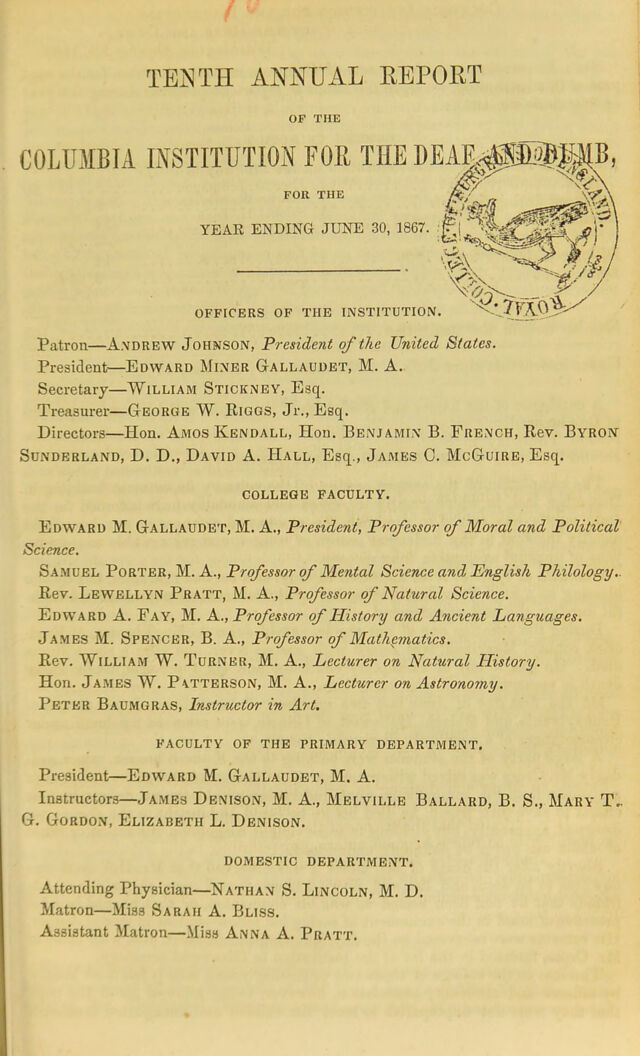
Tenth annual report of the Columbia Institution for the Deaf and Dumb, for the year ending June 30, 1867.
- Columbia Institution for the Deaf and Dumb (Washington, D.C.)
- Date:
- 1867
Licence: Public Domain Mark
Credit: Tenth annual report of the Columbia Institution for the Deaf and Dumb, for the year ending June 30, 1867. Source: Wellcome Collection.
Provider: This material has been provided by The Royal College of Surgeons of England. The original may be consulted at The Royal College of Surgeons of England.
47/64 page 41
![so much of the artificial in the supei-structure as may be effectively and reason- ably employed. ]Mr. Selesneff kindly furnished me with copies of works published in St. Petersburg, relating to the instruction of the deaf and dumb, involving ranch of historical interest. For the translation of portions of these books, I made arrangements before leaving Russia, and shall hope, hereafter, to present them to you and the public in our own language. THE INSTITUTION AT ABO, FINLAND. A flourishing school of forty-eight pupils, founded in eighteen hundred and sixty, exists in this distant city, where I spent a few hours on a Sunday night in July, as the steamer in which I was proceeding from St. Petersburg to Stockholm paused to receive and discharge freight. The appearance of the buildings, and the admirable arrangement of school appliances, fully equal to that in our best institutions, led me to regret greatly the absence of the pupils, and of the director. Rev. 0. H. Alopaeus. This gentleman was, however, kind enough to send me, some weeks after my call, detailed information as to the existing condition of deaf-mute instruction in Finland, including a translation into French of his last annual report. From the documents thus fux-uished, I learn that the sign language and man- ual alphabet with written language, are mainly relied on as the means of in- struction. Articulation has been taught for the last two years; not, however, being attempted with all the pupils. A somewhat unique arrangement exists herein respect to the division and em- ployment of time. The hours of school are daily from eight to one o’clock; and in the afternoon the pupils are engaged in manual labor; the girls in the insti- tution, and the boys, some in the shops of the establishment, and others as apprentices to mechanics in the town. * The history of deaf-mute instruction in Finland, as I have gathered it from various sources, presents many features of unusual interest, not the least surprising of which is the fact that schools were in operation here for year^ before any provision was made by private charity or public appropriation for the education of mutes in the capital of the United States. THE INSTITUTION AT STOCKHOLM, SWEDE.N. After Bordeaux I found here more beautiful buildings than in any institution I have seen on the continent of Europe. Founded in the first decade of the present century by Mr. P. A. Borg, (the father of the present director,) this establishment secured in eighteen hundred and ten the assistance of the govern- ment of Sweden, which has from that time to the present recognized by liberal grants the obligation resting on a state to make provision for the education, even by unusual outlays, of such of its children as may be found laboring under natural defects. The location of this institution, on the banks of the river form- ing the principal entrance to the harbor of Stockholm, reminded me sti’ongly of that of the New York institution; and in the large grounds, more extensive than any I have met in my tour, ample range is afforded the pupils for exer- cise and recreation. A fine swimming pool, enclosed and surrounded with dressing-rooms, has re- cently been built on the shore of the river, wherein the pupils are required to bathe daily during the summer months. I will not occuyiy space in giving any description of the admirably planned and constructed buildings, further than to allude to the arrangements for the care of the sick. A corridor in the upper story of the main structure is set apart for hospital](https://iiif.wellcomecollection.org/image/b22345772_0049.jp2/full/800%2C/0/default.jpg)


 No text description is available for this image
 No text description is available for this image
 No text description is available for this image