The degenerations resulting from lesions of posterior nerve roots and from transverse lesions of the spinal cord in man : a study of twenty cases / by James Collier and E. Farquhar Buzzard.
- Collier, James
- Date:
- 1903
Licence: In copyright
Credit: The degenerations resulting from lesions of posterior nerve roots and from transverse lesions of the spinal cord in man : a study of twenty cases / by James Collier and E. Farquhar Buzzard. Source: Wellcome Collection.
Provider: This material has been provided by The Royal College of Surgeons of England. The original may be consulted at The Royal College of Surgeons of England.
17/74 (page 573)
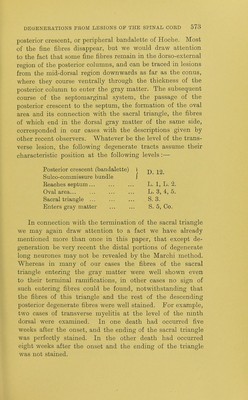
![posterior crescent, or peripheral bandalette of Hoche. Most of the fine fibres disappear, but we would draw attention to the fact that some fine fibres remain in the dorso-external region of the posterior columns, and can be traced in lesions from the mid-dorsal region downwards as far as the conus, w'here they course ventrally through the thickness of the posterior column to enter the gray matter. The subsequent course of the septomarginal system, the passage of the posterior crescent to the septum, the formation of the oval area and its connection with the sacral triangle, the fibres of which end in the dorsal gray matter of the same side, corresponded in our cases with the descriptions given by other recent observers. Whatever be the level of the trans- verse lesion, the following degenerate tracts assume their characteristic position at the following levels:— Posterior crescent (bandalette) ] Sulco-commissure bundle I Beaches septum... Oval area... Sacral triangle ... Enters gray matter D. 12. L. 1, L. 2. L. 3, 4, 5. S. 3. S. 5, Co. In connection with the termination of the sacral triangle we may again draw attention to a fact we have already mentioned more than once in this paper, that except de- generation be very recent the distal portions of degenerate long neurones may not be revealed by the March! method. Whereas in many of our cases the fibres of the sacral triangle entering the gray matter were well shown even to their terminal ramifications, in other cases no sign of such entering fibres could be found, notwithstanding that the fibres of this triangle and the rest of the descending posterior degenerate fibres were well stained. For example, two cases of transverse myelitis at the level of the ninth dorsal were examined. In one death had occurred five weeks after the onset, and the ending of the sacral triangle was perfectly stained. In the other death had occurred eight weeks after the onset and the ending of the triangle was not stained.](https://iiif.wellcomecollection.org/image/b22394734_0019.jp2/full/800%2C/0/default.jpg)