A textbook of human physiology / translated from [the] 6th German edition by W. Stirling.
- Landois, Leonard
- Date:
- 1888
Licence: Public Domain Mark
Credit: A textbook of human physiology / translated from [the] 6th German edition by W. Stirling. Source: Wellcome Collection.
Provider: This material has been provided by Royal College of Physicians, London. The original may be consulted at Royal College of Physicians, London.
159/980 page 107
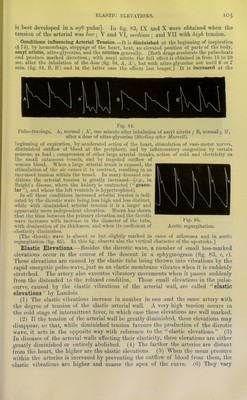
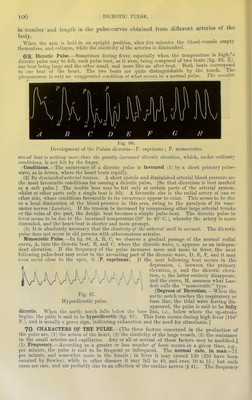
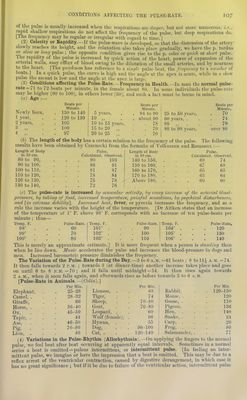
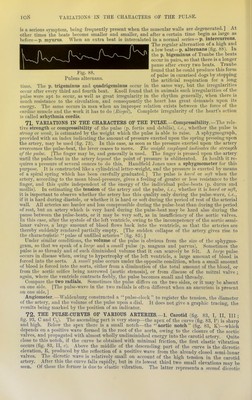
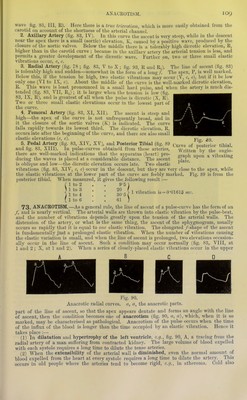
![of the pulse is usually increased when the resi>iratioiis are dvepcv, but not more numerous, i.e., rapid shallow respirations do not atleet the frequency of the pulse, but ilcep resiiirations do. [The lre(iuency may be regular or irregular with regard to time.] (2) Celerity or Rapidity.—If the pulse-wave is developed, so that the distension of the arterv' slowly reaches its height, and the relaxation also takes place gradually, we have the p. tardus or slow ov long T^x\\s% \ the opposite condition gives rise to the^p. celiiv ov quick ov short i)uls Ihe rapidity of the pulse is increased by quick action of the heart, power of expansion of tl se. arterial walls, easy efflux of blood owing to the dilatation of the small arteries, and by nearness to the heart. [The quickness has reference to a single pulse-beat, the frequencij to ri'number of beats.] In a quick pulse, the curve is high and the angle at the ape.x is acute, while in a slow pulse the ascent is low and the angle at the apex is large. (3) Conditions afifecting the Pnlse-Rate.—Frequency in Health. -In man tlu'normal pulse- rate = 71 to 72 beats per minute, in the female about 80. lu some individuals the pulse-riite may be higher (90 to 100), in others lower (50), and such a fact must be borne in minil. («) Age Newly born, 1 year, 2 years, 3 „ 4 ,. Heats pel- Minute. 130 to 140 120 to 130 105 100 97 5 years, 10 „ 10 to 15 15 to 20 20 to 25 year. Bents per Minute. 94 to 90 about 90 7 . 70 . 70 25 to 50 years, 60 years, . 80 „ . 80 to 90 years, Beats per Minute, 70 74 79 over 80 (i) The length of the body has a certain relation to the fre(iuency of the jjulse. The following results have been obtained by Czarnecki from the formuhe of Volkmann and Ranieaux :— Length of Body in 10 cm. 80 to 90, Pulse. Calculateil. Observed. 90 86 81 78 75 •1 103 91 87 84 78 76 Length of Body in 10 cm. 140 to 150, 150 to 160, 160 to 170, 170 to 180. Above 180, Pulse. Calculated. Observed. 69 67 65 63 60 74 68 65 64 60 fre(|uent when a person is standing than increases the blood-prcssure in dogs and 90 to 100, 100 to 110, 110 to 120, 120 to 130, 130 to 140, . . . /: (c) The pulse-rate is increased b>/ muscular activiti/, by every increase of the arterial blood- pressure, by taking of food, increased tcinperature, iminful sensations, by ■psychical disturbances, and [in extreme debility]. Increased heat, fever, or pyrexia increases the fre<|uency, and as a rule the increase varies with the height of the temperature. [Dr Aitken states that an increase of the temperature of 1° F. above 98 F. corresponds with an increa.se of ten pulse-beats per minute ; thus— Temp. F. Pulse-Rate. Temp. F. Pulse-Kate. Temp. F. Pulse-Hate, 98 ... 60 lOr ... 90 104 ... 120 99° . . . 70 102' . . .100 105 ... 130 100° ... 80 103 ... 110 106 ... 140 This is merely an approximate estimate.] It is more when he lies down. Music accelerates the pulse and men. Increased barometric pressure diminishes the frequency. The Variation of the Pnlse-Eate during the Day.—3 to 6 .\. Af. = 61 beats ; 8 to 11A A. m. = 74. It then falls towards 2 p.m. ; towards 3 (at dinner-time) another increase takes place and goes on until 6 to 8 p.m. =70; and it falls until midnight = 54. It then rises again towards 2 A.M., when it soon falls again, and afterwai-ds rises as before towards 3 to 6 a.m. [Pulse-Rate in Animals.—{Colin).] Elephant, Camel, . Giratie, Horse, . Ox, . . . Tapir, . Ass, Pig, . Lion, . (4) Variations in the Pulse-Rhythm (Allorhythmia).—Onai)plying the fingers to the normal pulse, we feel beat after beat occurring at apparently equal intervals. Sometimes in a normal series a beat is omitted = pulsus intermittens, or intermittent pulse. [In feeling an inter- mittent pulse, we imagine or have the impression that a beat is omitted. This may be due to a reflex arrest of the ventricular contraction, caused by digestive derangement, in which case it has no great significance ; but if it be due to failure of the ventricular action, intermittent luilsc Per Min. Per Min. Per Min. 25-28 Lioness, 68 Rabbit. . 120-151) 28-32 Tiger, . 74 Mouse, . 120 66 Sheep, 70-80 Goose, . 110 36-40 Goat, 70-80 Pigeon, 136 45-50 Leopard, . 60 Hen. . 14(1 44 Wolf (female), 96 Snake, . 24 46-50 Hya?ua, . 55 Carp, . 20 70-80 Dog, 90-100 Frug, . 80 40 Cat, . . 120-140 Salamandfi', . 77](https://iiif.wellcomecollection.org/image/b24757330_0159.jp2/full/800%2C/0/default.jpg)
 No text description is available for this image
 No text description is available for this image
 No text description is available for this image