A textbook of human physiology / translated from [the] 6th German edition by W. Stirling.
- Landois, Leonard
- Date:
- 1888
Licence: Public Domain Mark
Credit: A textbook of human physiology / translated from [the] 6th German edition by W. Stirling. Source: Wellcome Collection.
Provider: This material has been provided by Royal College of Physicians, London. The original may be consulted at Royal College of Physicians, London.
162/980 page 110
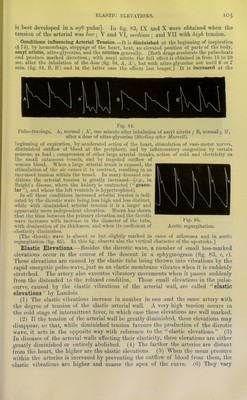
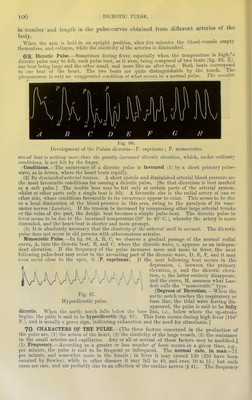
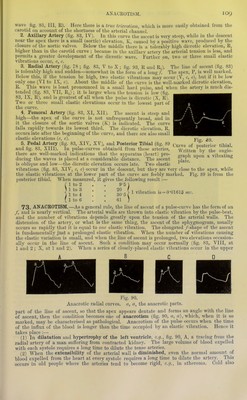
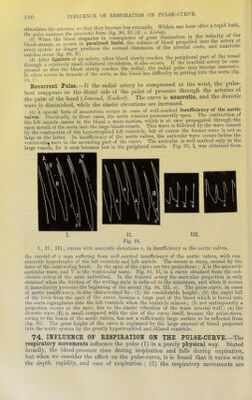
![stimulates tl.e arte.ie., so tliat they become less extensile. AVithin one hour after a tepid bath, the pulse assumes the anacrotic fonn (fig. 90, D) {G v. Licbui). velocity of the (3) AVheu the blood stagnates in consequence of great dmmnition m the jelocity oi tne bliod- rS, as occurs in Valysed limbs, the volun.e of blood l^Ff'l^i f .^^^^^^ every systole no longer produces the normal distension of the arterial coats, and anacrotic 1i!''Jf?nigaturo/^an arterv, when blood slowly reaches the peripheral part of the vessel throu4 a lelftively small collateral circulation, it also occurs If the brachial ^^^''T X' pressed so that the blood slowly reaches the radial, the radial pulse may become anaciotic. It often oc<;urs in stenosis of the aorta, as the blood has difficulty in getting into the aorta (fig. Recurrent Pulse.—If the radial artery be compressed at the wrist, the pulse- beat reappears on the distal side of the point of pressure through the arteries of the palm of the hand {Janaud, Xeidert). The curve is anacrotic, and the dicrotic wave is diminished, while the elastic elevations are increased. (5) *A special form of anacrotism occurs in cases of well-marked insuflBciency of the aortic valves. Tractically, in these cases, the aorta remains permanently open. Ihe contraction ot the left auricle causes in the blood a wave-motion, which is at once propagated througli the open mouth of the aorta into the large blood-vessels. This wave is followed by the wave caused by the contraction of the hypertrophied left ventricle, but of course the former wave is not so large as the latter. In insufficiency of the aortic valves, the auricular wave occurs before the ventriculaii wave in the ascending part of the curve. The auricular is well marked only in the large vessels, for it soon becomes lost in the peripheral vessels. Fig. 91, I, was obtained from I. II. Fig. 91. 1., II., III., curves with anacrotic elevations a, in insufficiency oi the aortic valves. the carotid of a man suffering from vcU-markcd insufficiency of the aortic valves, with con siderable hypertro])hy of the left ventricle and left auricle. The ascent is steep, caused by the force of the contracting heart. In the apex of the curve are two projections ; A is the anacrotic auricular wave, and V is the ventricular wave. Fig. 91, II, is a curve obtained from the sub- rlavinn artery of the same individual. In the femoral artery the auricular projection is only obtained when the friction of the writing-style is reduced to the minimum, and when it occurs it immediately precedes the beginning of the ascent (fig. 86, III, a). The pulse-curve, in cases of aortic insufFK iency, is also characterised by—(1) its considerable height; (2) the rapid fall of the lever from the apex of tlie curve, because a large part of the blood which is forced into the aorta regurgitates into the left ventricle when the ventricle relaxes ; (3) not unfrequently a projection occurs at the apex, due to the elastic vibration of the tense arterial wall ; (4) the dicrotic wave (R) is small compared with the size of the curve itself, because the pulse-wave, owing to the lesion of the aortic valves, has not a .sufficiently large surface to be rellected from (fig. 8.>). Tlie great height of the curve is explained by the large amount of blood projected into the aortic system by the greatly hypertrophied and dilated ventricle. 74. INFLUENCE OF RESPIRATION ON THE PTJLSE-CURVE.—The respiratory movements influence the pulse (1) in a purely physical way. Stated broadly, the blood-pres.sure rises during inspiration and falls during expiration, but when we consider the effect on the pulse-curve, it is found that it varies with the depth, rapidity, and ease of respiration ; (2) the respiratory movements are](https://iiif.wellcomecollection.org/image/b24757330_0162.jp2/full/800%2C/0/default.jpg)
 No text description is available for this image
 No text description is available for this image
 No text description is available for this image