A textbook of human physiology / translated from [the] 6th German edition by W. Stirling.
- Landois, Leonard
- Date:
- 1888
Licence: Public Domain Mark
Credit: A textbook of human physiology / translated from [the] 6th German edition by W. Stirling. Source: Wellcome Collection.
Provider: This material has been provided by Royal College of Physicians, London. The original may be consulted at Royal College of Physicians, London.
170/980 page 118
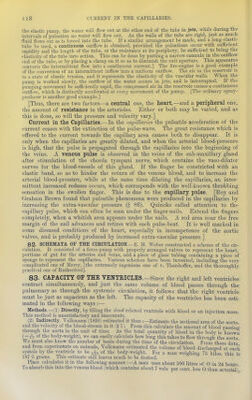
![the elastic pump, the water will flow o\it at the other end of the tube in jets, while during the intervals of pulsation no water will flow out. As the walls of the tube are rigid, just as much fluid flows out as is forced into the tube. If a similar arrangement be made, and a long elastic tube be used, a continuous outflow is obtained, provided the pulsations occur with sufficient rajndity and the length of the tube, or the resistance at its periphery, be sutticient to bring the elasticity of the tube into action. This can be done by putting a narrow cannula in the outflow end of the tube, or by placing a clamp on it so as to diminish the exit aperture. This apparatus converts the intermittent flow into a continuous current.] The fire-engine is a good example of the conversion of an intermittent inflow into a uniform outflow. The air in the reservoir is in a state of elastic tension, and it represents the elasticity of the vascular walls. AVhen the pump is worked slowly, the outflow of the water occurs in jets, and is interrupted. If tlie pumping movement be sufficiently rapid, the compressed air in the reservoir causes a continuous outflow, which is distinctly accelerated at every movement of the pump. [Tlie ordinary spray- [iroducer is another good example.] [Thus, there are two factors—a central one, the heart,—and a peripheral one, the amount of resistance in the arterioles. Either or both may be varied, and as this is done, so will the pressure and velocity vary.] Current in the Capillaries.—In the capillaries the pulsatile acceleration of the current ceases with the extinction of the pulse-wave. The great resistance which is offered to the current towards the capillary area causes both to disappear. It is only when the capillaries are greatly dilated, and when the arterial blood-pressure is high, that the pulse is propagated through the capillaries into the beginning of the veins. A venous pulse is observed in the veins of the sub-maxillary gland after stimulation of the chorda tympani nerve, which contains the vaso-dilator nerves for the blood-vessels of this gland. If the finger be constricted with an elastic band, so as to hinder the return of the venous blood, and to increase the arterial blood-pressure, while at the same time dilating the capillaries, an inter- mittent increased redness occurs, which corresponds with the well-known throbbing sensation in the swollen finger. This is due to the capillary pulse. [Roy and Graham Brown found that pulsatile phenomena were produced in the capillaries by increasing the extra-vascular pressure (§ 86). Quincke called attention to the capillary pulse, which can often be seen under the finger-nails. Extend the fingers completely, when a whitish area appears under the nails. A red area near the free margin of the nail advances and retires with each pulse-beat. It is well marked in some diseased conditions of the heart, especially in incompetence of the aortic valves, and is probably produced by increased extra-vascular pressure.] 82. SCHEMATA OF THE CIRCULATION.—E. H. Weber constructed a scheme of the cir- culation. It consisted of a force-pump with properly arranged valves to represent the heart, portions of gut for the arteries and veins, and a piece of glass tubing containing a piece of sponge to represent the capillaries. Various schemes have been invented, including the verv complicated one of ^Mavey, [the extremely ingenious one of v. Thanhoff'er, and the thoroughly juactical one of Rutherford]. 83. CAPACITY OF THE VENTRICLES.—Since the right and left ventricles contract simultaneously, and just the same volume of blood passes through the pulmonary as through the systemic circulation, it follows that the right ventricle must be just as capacious as the left. The capacity of the ventricles has been esti- mated in the following ways :— ^ Methods.—(1) Directly, by filling the dead relaxed ventricle with blood or an injection mass. This method is unsatisfactory and inaccurate. (2) Indirectly. Yolkmann (1850) estimated it thus :—Estimate the sectional area of the aorta, and the velocity of the blood-stream in it (§ 1). From this calculate the amount of blood passino- through the aorta in the unit of time. As the total quantity of blood in the body is known ( =T5 of the body-weight), we can easily calculate how long this takes to flow through the aorta We must also know the number of beats during the time of the circulation. From these data and from experiments on animals, Volkmann estimated the volume of blood discharged at each systole by the ventricle to be of the body-weight. For a man weighing 75 kilos this is 187 5 grams. This estimate still leaves much to be desired. Place calculates it in the following manner :—A man uses about 500 litres of 0 in 24 hours To absorb this into the venous blood (which contains about 7 vols per cent, less 0 than arterial)](https://iiif.wellcomecollection.org/image/b24757330_0170.jp2/full/800%2C/0/default.jpg)
 No text description is available for this image
 No text description is available for this image
 No text description is available for this image