A textbook of human physiology / translated from [the] 6th German edition by W. Stirling.
- Landois, Leonard
- Date:
- 1888
Licence: Public Domain Mark
Credit: A textbook of human physiology / translated from [the] 6th German edition by W. Stirling. Source: Wellcome Collection.
Provider: This material has been provided by Royal College of Physicians, London. The original may be consulted at Royal College of Physicians, London.
171/980 page 119
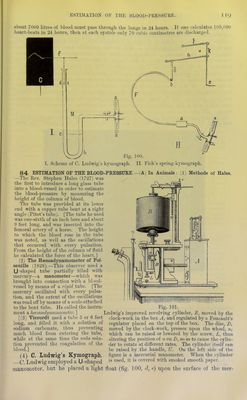
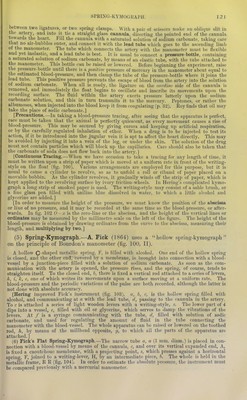
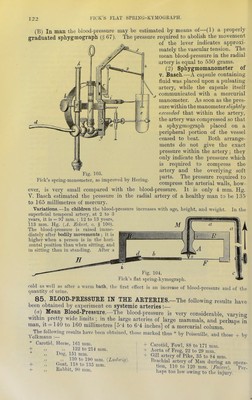
![about 7000 litres of Vilood must pass through the hiiigs in 24 hours. If one calculates 100,000 heart-beats in 24 hours, then at each systole only 70 c-uhic centimetres are discliargcd. Fig. 100. I. Scheme of C. Ludwig's kymograph. II. Pick's spring-kymograph. 84. ESTIMATION OF THE BLOOD-PEESSURE.—(A) In Animals : (1) Methods of Hales. —The Rev. Stephen Hales (1727) was the first to introduce a long glass tube into a blood-vessel in order to estimate the blood-pressure by measuring the height of the column of blood. The tube was provided at its lower end with a copper tube bent at a right angle (Pilot's tube). [The tube he used was one-si.\th of an inch bore and about 9 feet long, and was inserted into the femoral artery of a horse. Tlie height to which the blood rose in the tube was noted, as well as the oscillations that occurred with every pulsation. From the height of the column of fluid he calculated the force of the Iieart.] (2) The HaBmadynamometer of Poi- seuille (1828).—This observer used a U-shaped tube partially filled with mercury—a manometer—which was brought into connection with a bl.>od- vessel by means of a rkjid tube. [The mercury oscillated with every pulsa- tion, and the e.xtent of the oscillations was read of! by means of a scale attached to the bent tube. He called the instru- ment a lucinadynamoindcr.^ [(3) Vierordt used a tube 5 or 6 feet long, and filled it with a solution of sodium carbonate, thus preventing much blood from entering the tube, while at the same time the soda solu- tion prevented the coagulation of the blood.] (4) C. Ludwig's Kymograph. —C. Ludwig employed a U-shaped raanometer, but he placed a light float (fig. 100, d, ■'<) upon the surface of the mer- Fig. 101. Ludwig's im]iroved revolving cylinder, R, moved by the clock-work in the box A, and regulated by a Foucault's regulator placed on the top of the box. The disc, I), moved by the clock-work, presses upon the wheel, n, which can be raised or lowered by the screw, Z, thus altering the position of n on D, so as to cause the cylin- der to rotate at different rates. The cylinder itself can be raised by the handle, U. On the left side of the figure is a nierciu'ial manometer. When the cylinder is used, it is covered with smoked smooth paper.](https://iiif.wellcomecollection.org/image/b24757330_0171.jp2/full/800%2C/0/default.jpg)
 No text description is available for this image
 No text description is available for this image
 No text description is available for this image