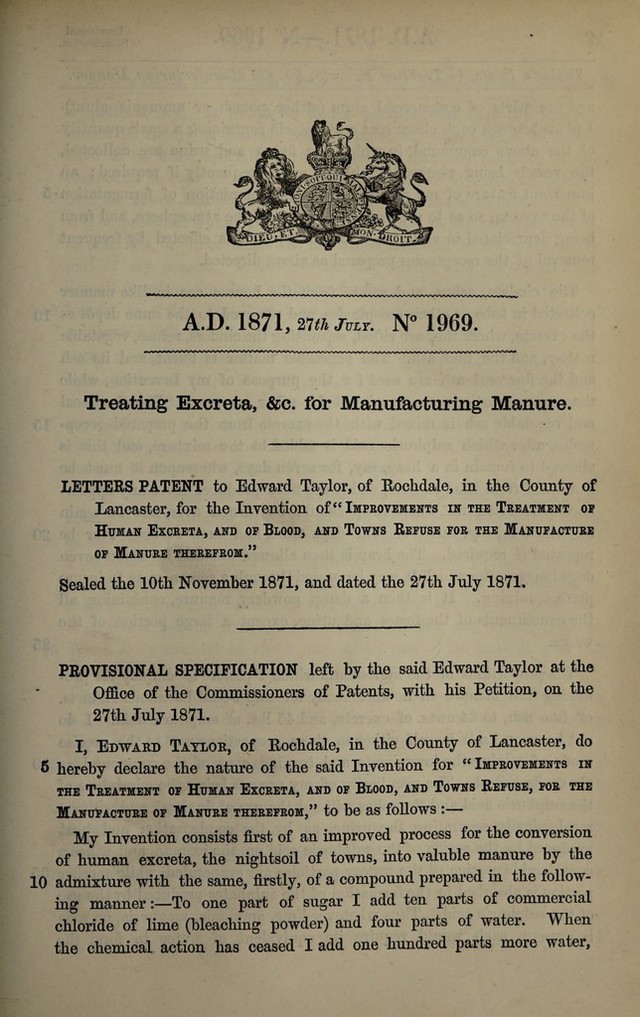
Specification of Edward Taylor : treating excreta, &c. for manufacturing manure.
- Taylor, Edward, 1959-
- Date:
- 1872
Licence: Public Domain Mark
Credit: Specification of Edward Taylor : treating excreta, &c. for manufacturing manure. Source: Wellcome Collection.
5/10 page 3
![Provisional Specification. A.D. 1871.—N° 1909. 3 Taylor's Impts. in Treating Excreta, Sfc. for Manufacturing Manure. crystallized salt. It would be found advantageous that the fine ash should be as dry as possible before admixture, even though it should have to be dried specially for the purpose, also any tendency of the compound to char should be carefully prevented by frequent turning 5 over as above described. With these precautions a valuable manure will be produced which will allow of the addition of nitrates, phosphates, or chlorides, or other materials, but which addition is not a necessary part of my process. I also use for the mixing with the excreta the deposit found in the flues of large furnaces and boiler fires, which is 10 known as “ flue dust,’ * and which contains a valuable quantity of sulphuric acid. By the above method of collecting and treating the nightsoil and refuse of towns there is nothing lost, all is made profitably available, the cinders will be found sufficient to raise steam for any motive power 15 required in the process of preparing the manure, and for all drying and evaporating purposes, and all other kinds of refuse, such as glass, iron, etc. can be disposed of for their usual purposes. The urine from the public urinals and that portion which can be collected from dwelling houses, I treat as follows :—I put into the tanks 20 of the urinals a quantity of the same before described mixture, which I put into the receptacles for nightsoil, and I collect the urine at least once a week and take it to the depot. It is there evaporated whilst in a state of freshness before decomposition has set in, and thus the evaporation can be accomplished without causing any offensive smell. 25 When it is reduced to about one-eighth part of its bulk it may bo thrown on the before described prepared manure. The blood from the slaughter houses I treat as follows When the animal is slain I catch the blood in a vessel containing the common commercial alum, in the proportion of 1/2oth part of alum to the blood, 30 the blood immediately solidifies, and can be conveniently carried, being free from the danger of spilling, and from offensiveness, it can also be dried on hot iron plates without giving off offensive smell. After drying it can be ground up with the nightsoil manure before described, or if required it may be sold as a separate manure. It may be mixed with 35 dry clay, a convenient proportion would be ]/6th part of clay to one part of blood.](https://iiif.wellcomecollection.org/image/b30757605_0005.jp2/full/800%2C/0/default.jpg)