Plastic apparatus in surgery : with especial reference to that variety made with plaster of Paris / by Samuel B. St. John.
- St. John, Samuel B., 1813-1876.
- Date:
- 1872
Licence: Public Domain Mark
Credit: Plastic apparatus in surgery : with especial reference to that variety made with plaster of Paris / by Samuel B. St. John. Source: Wellcome Collection.
Provider: This material has been provided by The Royal College of Surgeons of England. The original may be consulted at The Royal College of Surgeons of England.
3/40
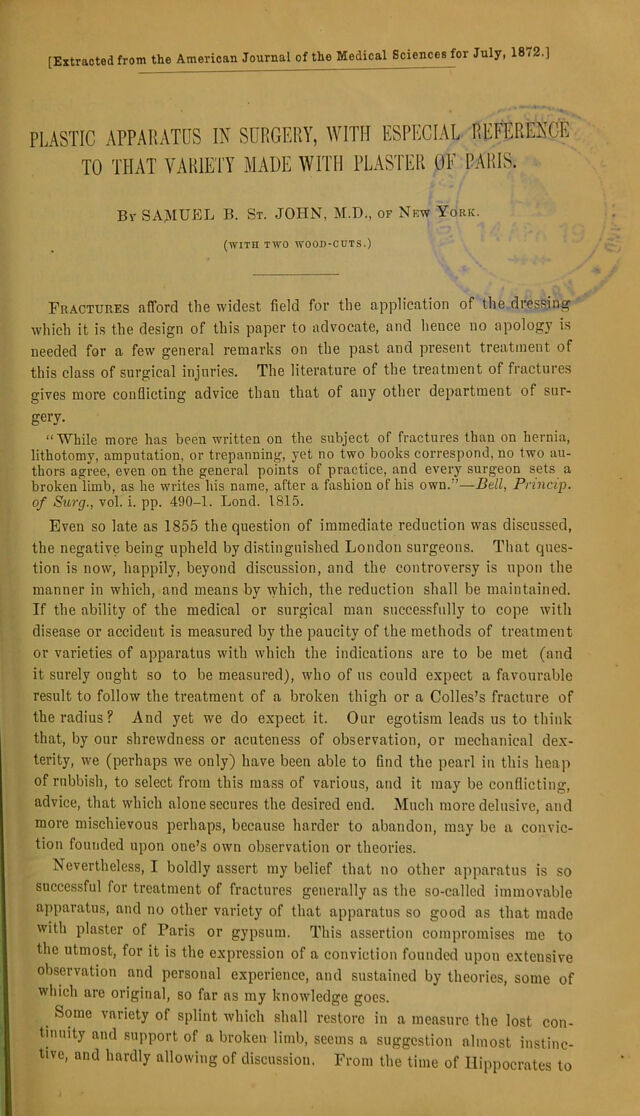
![[Extracted from the American Journal of the Medical Sciences^or July, 1872.] PLASTIC APPARATUS IN SURGERY, WITH ESPECIAL REFERENCE TO THAT VARIETY MADE WITH PLASTER OF PARIS. By SAMUEL B. St. JOHN, M.D., of Nf.w York, (with two wood-cuts.) Fractures afford the widest field for the application of the dressing which it is the design of this paper to advocate, and hence no apology is needed for a few general remarks on the past and present treatment of this class of surgical injuries. The literature of the treatment of fractures gives more conflicting advice than that of any other department of sur- gery. “While more has been written on the subject of fractures than on hernia, lithotomy, amputation, or trepanning, yet no two books correspond, no two au- thors agree, even on the general points of practice, and every surgeon sets a broken limb, as he writes his name, after a fashion of his own.'—Bell, Prtncip. of Surg., vol. i. pp. 490-1. Lond. 1815. Even so late as 1855 the question of immediate reduction was discussed, the negative being upheld by distinguished London surgeons. That ques- tion is now, happily, beyond discussion, and the controversy is upon the manner in which, and means by which, the reduction shall be maintained. If the ability of the medical or surgical man successfully to cope with disease or accident is measured by the paucity of the methods of treatment or varieties of apparatus with which the indications are to be met (and it surely ought so to be measured), who of us could expect a favourable result to follow the treatment of a broken thigh or a Colies’s fracture of the radius? And yet we do expect it. Our egotism leads us to think that, by our shrewdness or acuteness of observation, or mechanical dex- terity, we (perhaps we only) have been able to find the pearl in this heap of rubbish, to select from this mass of various, and it may be conflicting, advice, that which alone secures the desired end. Much more delusive, and more mischievous perhaps, because harder to abandon, may be a convic- tion founded upon one’s own observation or theories. Nevertheless, I boldly assert my belief that no other apparatus is so successful for treatment of fractures generally as the so-called immovable apparatus, and no other variety of that apparatus so good as that made with plaster of Paris or gypsum. This assertion compromises me to the utmost, for it is the expression of a conviction founded upon extensive observation and personal experience, and sustained by theories, some of which are original, so far as my knowledge goes. Some variety of splint which shall restore in a measure the lost con- tinuity and support of a broken limb, seems a suggestion almost instinc- tive, and hardly allowing of discussion. From the time of Hippocrates to](https://iiif.wellcomecollection.org/image/b22457732_0005.jp2/full/800%2C/0/default.jpg)