Plastic apparatus in surgery : with especial reference to that variety made with plaster of Paris / by Samuel B. St. John.
- St. John, Samuel B., 1813-1876.
- Date:
- 1872
Licence: Public Domain Mark
Credit: Plastic apparatus in surgery : with especial reference to that variety made with plaster of Paris / by Samuel B. St. John. Source: Wellcome Collection.
Provider: This material has been provided by The Royal College of Surgeons of England. The original may be consulted at The Royal College of Surgeons of England.
4/40 page 2
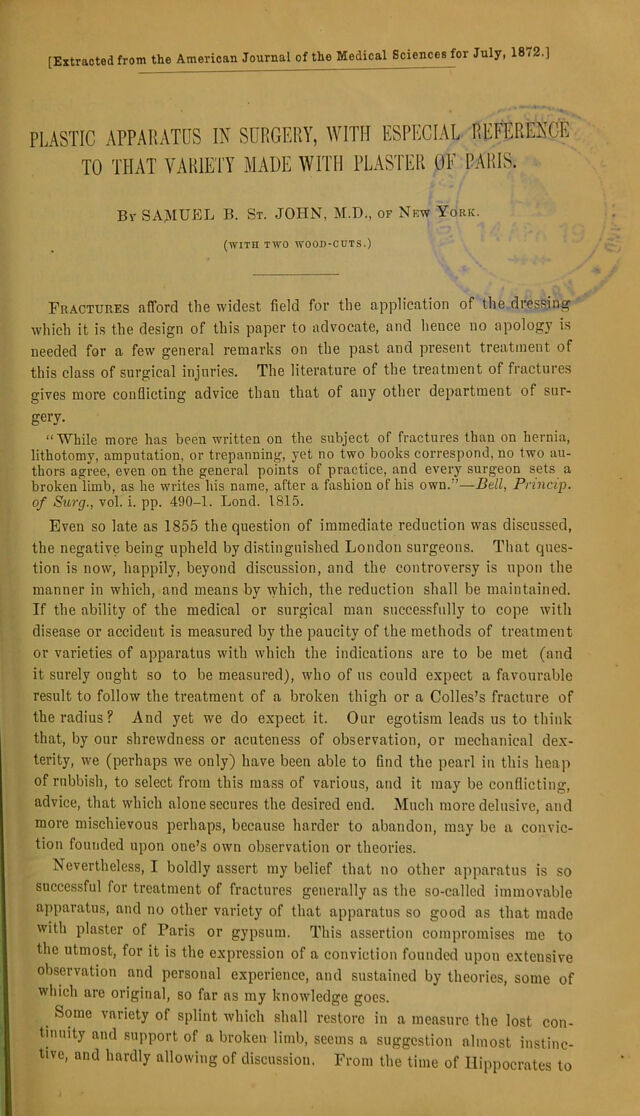
![1!GS, splints of some kind, generally short wooden strips, were bound around a fracture with this object in view. In 1168 Percival Pott pub- lished a paper (a Few General Remarks on Fractures and Dislocations. Clrir. Works, vol. i. p. 221) in which he argued that the deformity, pain, and general distress attendant upon a fracture, were due entirely to irreg- ular muscular action, and could be removed entirely by relaxing the muscles by position. His arguments were specious and forcibly conveyed, but they failed to secure the general adoption of his plan, for it was evident that he had lost sight of physical laws, which have so prominent a part in producing deformity and consequent pain ; the distal end of a fractured limb falling by its own weight or failing to follow the proximal end, when that is moved either by accident or design. The muscular relaxation, too, it was seen, must be but partial, for the complete relaxation of a flexor group puts the extensors on the stretch, and vice versa, so that a compro- mise, or semi-relaxation of both, is the best that can be had. Mr. Pott gives no statistics with his paper, showing results, but he says that this postural method “will not only succeed in all those cases in which the old method [by splints firmly applied] can ever be successful; but also in the majority of those in which it is not, nor, in the nature of things, can.” We notice also that he alludes to splints, which, according to Sir James Earle, he habitually used, and he insists upon having them extend over the joints above and below the fracture, and upon haviug them secured loosely, instead of firmly, as was then the general custom. It is easy to see that these long splints, though loosely bound on, would give more efficient support to a broken limb than the shorter ones then in vogue, be they bound never so tightly, so that Mr. Pott’s practice was not such a revolution after all as at first sight it would seem. The probability is, that those cases which did well without any splints were those in which there was little or no tendency to displacement, and we confess to a disappointment in not having statistics of a number of cases of fracture of the femur giving the amount of shortening, where the treatment consisted simply in laying the limb upon a pillow in a flexed position. Splints, therefore, still held their sway, and improvements were contin- ually made in them as to lightness and adaptability to the affected limb. They were made of every conceivable material—straw, bundles of reeds or twigs, thin boards, sheet-iron, tin, wire, etc. Some of these were rudely moulded, to correspond to the contour of the limb, and the exten- sion of this idea is to be found, at present, in all our instrument shops, in the shape of the elegantly carved and polished wooden splints, made rights and lefts like shoes, and warranted to fit any one who is patterned after the ideal Apollo of the maker. These splints, of course, required padding, elaborately arranged in order to make them support the fracture adequately, and to prevent too great pressure upon salient points, and the position of the pads was the prominent feature in the surgical instruction upon the treatment of fractures. These pads were continually slipping out of place,](https://iiif.wellcomecollection.org/image/b22457732_0006.jp2/full/800%2C/0/default.jpg)