Loudon's encyclopædia of plants : comprising the specific character, description, culture, history, application in the arts, and every other desirable particular respecting all the plants indigenous to, cultivated in, or introduced to Britain / [J.C. Loudon].
- John Claudius Loudon
- Date:
- 1855
Licence: Public Domain Mark
Credit: Loudon's encyclopædia of plants : comprising the specific character, description, culture, history, application in the arts, and every other desirable particular respecting all the plants indigenous to, cultivated in, or introduced to Britain / [J.C. Loudon]. Source: Wellcome Collection.
56/1618 page 28
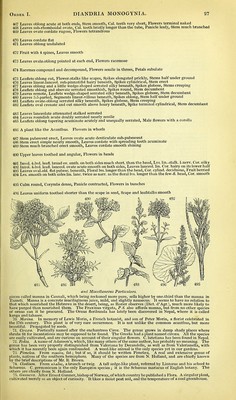
![BIGYNIA. 76. ANTHOXANTHUM. W. Spring-Grass. Graminere. Sp. 3—6. 497 odoratum W. sweet-scented * A ag 1 my Ap Britain me. pa. S h.l Eng. bot. 647 498 amarum Brot. bitter * A en 1 jl Ap Morocco 1810. S co 4C9 ovatum Lag. ovate * O cu 1 jl Ap Spain 1821. S co *77. Pl'PER. W. §500 coriaceum Vahl. 501 nitidum TV. 502 aduncum W. 503 macrophyllum JV. 504 genieulatum W. 505 hispidum W. 506 Amalago W. 507 Betle W. 508 nigrum W. §509 discolor TV. 510 reticulatum TV. 511 decumanum TV. 512Sirib6a TV. 513 longum P. S. 514 peltatum TV. 515 umbellatum TV. 516 laurifolium Mill. 517 tomentosum Mill. 518glabrum Mill. 519 racemosum Mill. §520 brachyphyllum TV. §521 amplexicaule TV. §522 magnolia?f61ium Fa. §523 obtu'sifolium TV. §524 cuneifolium TV. en. §525 alatum P. S. §526 acuminatum TV. en §527 distachyon P. S. §528 maculosum TV. §529 pellucidum TV. §530 pubescens H. S. §531 humile Vahl. §532 trifolium P.S. §533 pulchellum TV. §534 pereskioefolium W. §535blandum TV. §536 rubricaule Nees. §537 polystachion TV. §538 quadrifi'ilium Jf. §539 ineequalifolium §540 stellatum P. S. §541 incanum Haw. §542 subrotundum Haw § 543 rubellum ffiim. Pepper. leathery jt* ZD shining-leaved-tt ZD hooked J* ZD broad-leaved JH ZD swollen-joint'dJi ZD hairy-leaved -** ZD rough-leaved * ZD betle * ZD black !U ZD discoloured ZD netted -** ZD the great J* ZD Siriboa ZD long 3t Z3 peltated -n ZD umbelled js O laurel-leaved ja O downy s ZD smooth <fc I great racemose* I TRIGYNI A. F 3U 4 :u 3 cu 5 cu 12 cu 6 4 6 6 cu 6 clt 6 cu 2 cu 3 cu 10 cu 14 cu 10 cu 10 ipcracete. my.jn Ap my.jn Ap my Ap Ap Ap Ap Ap Ap Ap Ap A,) Ap Ap Ap Ap my.jl Ap Ap my.jn Ap Ap Ap jl jl.au jl.au Sp. 44—250. E. Indies Jamaica Jamaica W. Indies Jamaica Jamaica Jamaica E. Indies E. Indies W. Indies W. Indies Carthag. E. Indies E. Indies W. Indies W. Indies W. Indies W. Indies Campeac. Campeac. 1815. C 1793. C 1748. C 1800. 1823. 1793. 1759. 1804. 1790. 1821. 1748. 176S. 1768. 1788. 1748. 1748. 1768. 1768. 1768. 1768. r.m Bot. cab. 128 r.m r.m Jac. ic. 2. t. 210 r.m Slo. jam. 88. f. 1 r.m r.m r.m Slo.hist.l.t.87.f.l r.m Rheede. 7.1.15 r.m Lam. ill. 79. t. 23 r.m Bot. cab. 610 r.m Plumier. 57. t.75 r.m Jacq. ic. 2. t. 215 r.m Humph. 5. 1.117 r.m Rump.5. t.H6.f.2 r.m Plumier. 56. t. 74 l.p Plumier. 53. t. 73 r.m r.m r.m r.m short-leaved stem-clasping magnolia-lvd. obtuse-leaved wedge-leaved winged acuminate two-rowed spot-stalked pellucid pubescent low three-leaved small-leaved cactus-leaved villous red-stemmed many-spiked four-leaved unequal-leav'd]£ starry £ great-downy 2 sm. clusia-lvd. £ red I cu 23 cu I cu I cu za I cu za cu ZS cu 23 cu m cu 23 cu 23 cu 23 cu 23 cu 23 «'u 23 cu 23 cu 23 cu 23 cu 23 or 23 cu 23 cu 23 cu 23 cu I Ap 1 jn.s Ap 1£ ja.mr Ap 1 ap.jl Ap 1 jn.jl Ap 1 mr.ap Ap 1 jn.jl Ap 1| jn.jl Ap Ap Ap Ap Ap 5 ap.s 1 jl.o 1 jn.jl | jn.au Ap i jl.o Ap 1 my.jn Ap 1£ my.n Ap 1 my.jn Ap i jn.jl Ap A jn.jl Ap 1 jl.au Ap 1 my.jl Ap 1 f Ap 1 f Ap J mr.ap Ap S. Amer. 1818. W. Indies 1793. W. Indies 1793. W. Indies 1739. Caraccas 1809. S. Amer. 1812. W. Indies 1812. S. Amer. 1793. St. Domin.1790. S. Amer. 1748. S. Amer. 1809. W. Indies 1768. S. Amer. 1802. Jamaica 1778. S. Amer. Caraccas 1820. 1802. 1822. 1775. 1818. 1800. 1802. 1815. 1812. W. Indies 1S20. Jamaica S. Amer. Peru Jamaica Brazil r.m r.m r.m r.m r.m r.m r.m r.m r.m r.rn r.m r.m r.m r.m r.m r.m r.m r m r.m r.m r.m r.m r.m r.m Jac. ic. 2. t 213 Tr. ehrt. 54. t. 96 Jac. ic. 2. t. 214 Fl. per. 31. t. 48 Bot. mag. 1882 Plumier. 51. t. 67 Plumier. 60. t. 66 Plumier. 54. t. 72 Plumier. 52. t. 68 Bot. cab. 574 Hook. ex. fl. 67 Hook. ex. fl. 21 Hor. phys. br. t.8 Hook. ex. fl. 23 Hook. ex. fl. 22 PI. per. 1. t. 46. a Jac. vind. 2. t.2I7 Bot. cab. 503 Ho A. ex. fl. 59 History, Use, Propagation, Culture, 76. Antkoxanthum. From a».5o?, a flower, and l<x.vhs, yellow, the spikes being yellow. This grass has the valves of the calyx sprinkled over with minute yellow dots, similar to those of black-currant berries; hence, possibly, its peculiar scent. It is this grass which gives the peculiar smell to meadow-hay; that made from ray-grass or other sown-grasses having no such odour. It is one of the earliest flowering grasses, grows on any soil, but pre- fers one moderately dry. Stillingfleet recommends its being sown with a view to improve the flavor of mutton. But its seeds are collected with so much difficulty that they are too costly to be sown in any great quantity. 77. Piper. Undoubtedly from pippul, the Bengalese name of the long-pepper, notwithstanding the learned derivations of authors from zteitto, mm^i, to digest. The plants of this genus are mostly succulent, perennial, herbaceous, or frutescent; often scandent as in that species which furnishes the pepper of commerce; dichoto- mous and jointed. P. nigrum furnishes the pepper of commerce. It grows wild in the East Indies, and in Cochin China, and is cultivated in Malacca, Java, and especially in Sumatra. The pepper or seed is distinguished in the shops as black.gr white; the former is the dried berry in its natural state; the latter, the berry deprived of its skin, by steeping about a fortnight in water, and then drying in the sun. Black pepper is the hottest and strongest. As a spice, pepper differs from most others by its pungency residing not in the volatile parts or es- sential oil, but in a fixed substance, which does not rise in the heat of boiling water. The culture of the plant in the pepper farms of the East very much resembles that of the hop in England. Holes are made in prepared ground at from six to twelve feet a-part every way; in these from two to six cuttings of the pepper vines are](https://iiif.wellcomecollection.org/image/b21495725_0056.jp2/full/800%2C/0/default.jpg)


 No text description is available for this image
 No text description is available for this image
 No text description is available for this image