A pathological classification of mental disease / by J. Batty Tuke, M.D.
- Tuke, J. Batty, Sir (John Batty), 1835-1913.
- Date:
- [©1870?]
Licence: Public Domain Mark
Credit: A pathological classification of mental disease / by J. Batty Tuke, M.D. Source: Wellcome Collection.
Provider: This material has been provided by The University of Glasgow Library. The original may be consulted at The University of Glasgow Library.
16/22 page 14
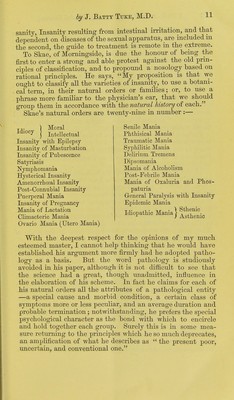
![Class Y.—Diathetic In- f Insanity of Tuberculosis, sanity. \ Syphilitic [nsanity. r Cretinism. Class YI.—Toxic In- J Delirium Tremens. sanity. \ Insanity of Alcoholism. Insanity from Opium-eating. ( Rheumatic Insanity. Class YII. — Metastatic J Pellagrous Insanity. Insanity. \ Metastatic Insanity (from healing of long-established issues). The first class has been universa,lly acknowledged in aU ages. Class II.—Idiophrenic Insanity.—Under this term I would include all forms of disease in which the Brain or its Membranes are primarily affected. It may be said, with some apparent degree of truth, that in it are comprised cer- tain of the best established and most universally acknow- ledged classes of Insanity, actual pathological entities, which deserve to be considered as separate and distinct self- contained classes, that it is in some degree lowering their nosological status to regard them as sub-classes, and that complication rather than simplification will result. To this I answer that the arrangement of them under one head, far from derogating from their position, tends to direct more particular attention to the facts on which their position has been established. They have a decided generic afiB.nity, in that they are the result of primary pathological changes of the brain plasm, however unappreciable these changes may be in the present state of science. Whatever the predispos- ing or exciting cause may be, the brain is the first organ to suffer degeneration; whether it be sudden shock inducing paralysis or irritation of certain organs of the cerebrum, or long-continued anxiety, loss of slee]3, or over-exertion of the brain, inducing a more rapid loss of tissue than the compen- satory powers of the individual can immediately restore, whether General Paresis, Phrenitic Insanity, or pure asthenic or sthenic Idiopathic Insanity result, we can ascribe them to one generic immediate pathological causation—^primary de- generation of brain plasm. I must admit to some difiiculty, in the case of General Paresis, for warrant of admission, pure et simple, into the class of Idiophrenic Insanity, as I find, on reference to tables of](https://iiif.wellcomecollection.org/image/b21479732_0016.jp2/full/800%2C/0/default.jpg)