Histone genes : structure, organization, and regulation / edited by Gary S. Stein, Janet L. Stein, William F. Marzluff.
- Date:
- [1984]
Licence: Attribution-NonCommercial-NoDerivatives 4.0 International (CC BY-NC-ND 4.0)
Credit: Histone genes : structure, organization, and regulation / edited by Gary S. Stein, Janet L. Stein, William F. Marzluff. Source: Wellcome Collection.
67/520 page 47
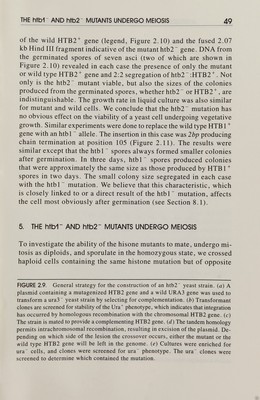
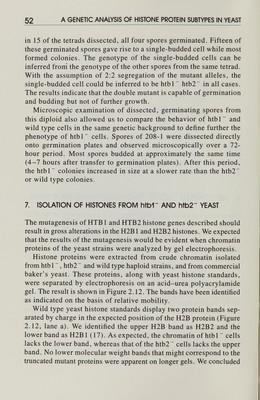
![INTRODUCTION OF HISTONE H2B AND H2A FRAMESHIFT MUTATIONS 47 h2b2 ATT GCT ACT GAft GCT AGC T ^^ ^ ]TC TAA mutant lie ala thr glu ala ser phe phe term H2B2 wild type ATT GCT ACT GAA GCT TCT AAA TTG GCC GCT GCC TAA ile ala thr glu ala ser lys leu ala ala ala term 76 80 83 '85 130 FIGURE 2.8. Frameshift mutation in histone HTB2 gene. a 2.07 kb Hind III fragment that resulted from the fusion of the two HTB2 containing Hind III fragments. The fused (2.07 kb) Hind III fragment has a frameshift mutation that alters the coding capacity of the HTB2 gene as shown in Figure 2.8. This DNA fragment was cloned into the yeast shuttle vector YIp5 to form the hybrid plasmid pMGlOl. The htb2~ allele was introduced into the yeast genome in two steps: integration of the cloned mutant gene by recombination with the genomic copy and excision of the wild type gene and vector sequences by intrachromosomal recombination. A diagram sum¬ marizing the approach is shown in Figure 2.9. The result was a diploid strain (GY109D-2) heterozygous for the htb2~ mutation. When the htb2~/HtB2'' diploid (GY109D-2) is sporulated, it should give rise to four haploid meiotic spores. Each of these will contain either the mutant (htb2~) or the wild (HTB2^) gene. By dissecting four-spored asci, we could determine the effect of the mutation on the viability of haploid cells. Two extreme possibilities exist. The htb~ mutation may be lethal in a haploid cell, resulting in the survival of only two spores per tetrad, those that are wild type for the histone HTB^ gene. Alternatively, the histone mutation may have little or no effect on spore germination and haploid cell viability. This would result in the germination of all four spores in a tetrad, and 2:2 seg¬ regation of HTB2^ :htb2~. To determine the effect of the htb2~ mutation on viability, diploid strain GY109D-2 (htb2~/HTB2^) was sporulated and dissected. Figure 2.10 shows the result of southern blot analysis of Hind Ill-digested DNA from the diploid and its haploid progeny. GY109D-2 (Figure 2.10) contains the 0.97 kb doublet Hind III fragments representative «I](https://iiif.wellcomecollection.org/image/b18024890_0068.JP2/full/800%2C/0/default.jpg)