The active principle of a bini spear poison / by P.P. Laidlaw.
- Laidlaw, Patrick P. (Patrick Playfair), Sir, 1881-1940.
- Date:
- [1909?]
Licence: Public Domain Mark
Credit: The active principle of a bini spear poison / by P.P. Laidlaw. Source: Wellcome Collection.
3/8
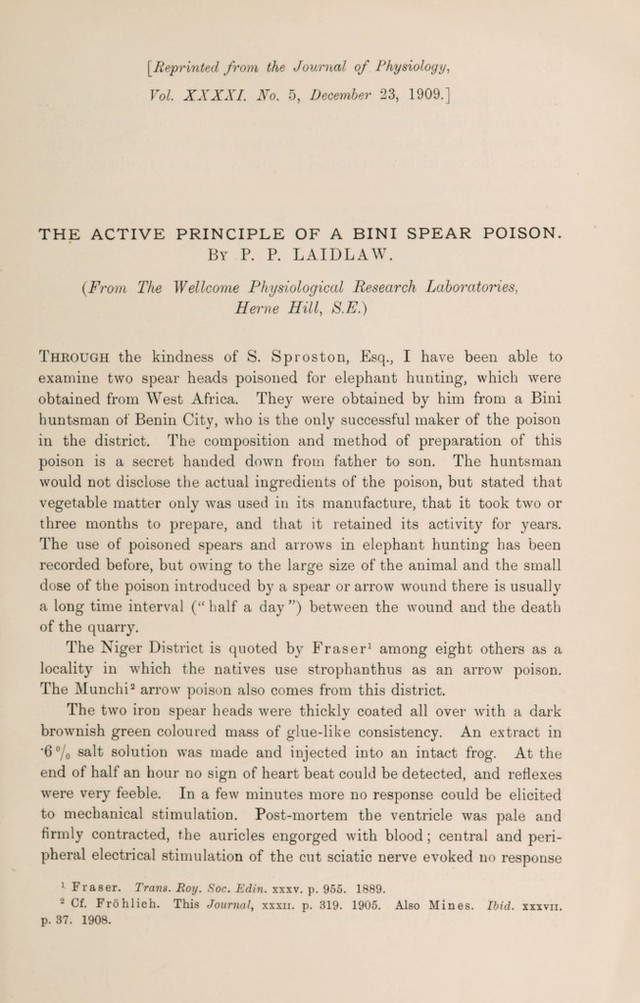
![[.Reprinted from the Journal of Physiology, Vol XXXXL No. 5, December 23, 1909.] THE ACTIVE PRINCIPLE OF A BINI SPEAR POISON. By P. P. LAIDLAW. (From The Wellcome Physiological Research Laboratories, Herne Hill, S.E.) Through the kindness of S. Sproston, Esq., I have been able to examine two spear heads poisoned for elephant hunting, which were obtained from West Africa. They were obtained by him from a Bini huntsman of Benin City, who is the only successful maker of the poison in the district. The composition and method of preparation of this poison is a secret handed down from father to son. The huntsman would not disclose the actual ingredients of the poison, but stated that vegetable matter only was used in its manufacture, that it took two or three months to prepare, and that it retained its activity for years. The use of poisoned spears and arrows in elephant hunting has been recorded before, but owing to the large size of the animal and the small dose of the poison introduced by a spear or arrow wound there is usually a long time interval (“ half a day ”) between the wound and the death of the quarry. The Niger District is quoted by Fraser1 among eight others as a locality in which the natives use strophanthus as an arrow poison. The Munchi2 arrow poison also comes from this district. The two iron spear heads were thickly coated all over with a dark brownish green coloured mass of glue-like consistency. An extract in '6 % salt solution was made and injected into an intact frog. At the end of half an hour no sign of heart beat could be detected, and reflexes were very feeble. In a few minutes more no response could be elicited to mechanical stimulation. Post-mortem the ventricle was pale and firmly contracted, the auricles engorged with blood; central and peri¬ pheral electrical stimulation of the cut sciatic nerve evoked no response 1 Fraser. Trans. Roy. Soc. Edin. xxxv. p. 955. 1889. 2 Cf. Frohlich. This Journal, xxxii. p. 319. 1905. Also Mines. Ibid, xxxvii. p. 37. 1908.](https://iiif.wellcomecollection.org/image/b30614132_0003.jp2/full/800%2C/0/default.jpg)