Natural history of British fishes : their structure, economic uses and capture by net and rod, cultivation of fish-ponds, fish suited for acclimatisation, artificial breeding of salmon / by Frank Buckland.
- Francis Trevelyan Buckland
- Date:
- [pref. 1880]
Licence: Public Domain Mark
Credit: Natural history of British fishes : their structure, economic uses and capture by net and rod, cultivation of fish-ponds, fish suited for acclimatisation, artificial breeding of salmon / by Frank Buckland. Source: Wellcome Collection.
35/444
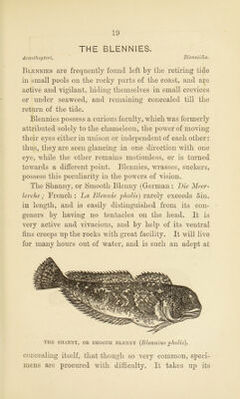
![10 THE BLENNIES. Acanthopteri. Blcnniid(e. Blennies are frequently fomicl left by the retiring tide in binall pools on tlie rocky parts of tlie coast, and are active and vigilant, biding themselves in small crevices or under seaweed, and remaining concealed till the return of the tide. Blennies possess a curious faculty, which was formerly attributed solely to the chameleon, the power of moving their eyes either in unison or independent of each other: thus, they are seen glancing in one direction with one eye, Avhile the other remains motionless, or is turned towards a different q>oint. Blennies, vuasses, suckers, possess this peculiarity in the powers of vision. The Shanny, or Smooth Blenny (German : Die Meer- Jerche; French : La BJennie ■pholis] rarely exceeds 5in. in length, and is easily distinguished from its con- geners by having no tentacles on the head. It is very active and vivacious, and by help of its ventral fins creeps up the rocks with great facility. It will live for many hours out of water, and is such an adept at THE SHANNY, OR SMOOTH BLENNY [BleniliuS plloUs). concealing itself, that though so very common, speci- mens are procured with difficulty. It takes up its](https://iiif.wellcomecollection.org/image/b28107391_0035.jp2/full/800%2C/0/default.jpg)




 No text description is available for this image
 No text description is available for this image
 No text description is available for this image