The development of inhalation anaesthesia : with special reference to the years 1846-1900... / [Barbara M. Duncum].
- Duncum, Barbara M.
- Date:
- 1947
Licence: In copyright
Credit: The development of inhalation anaesthesia : with special reference to the years 1846-1900... / [Barbara M. Duncum]. Source: Wellcome Collection.
343/664 page 323
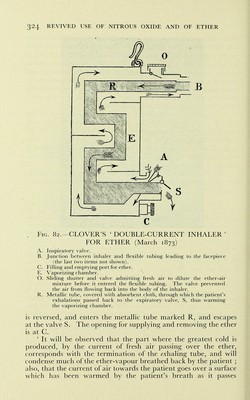
![vessel with a diaphragm of india-rubber membrane, which rises and falls with the breathing. This arrangement effects the same result with ether which I produced by the supplemental bag of my nitrous oxide apparatus [see Fig. 71]. The patient inhales almost the same atmosphere over and over again, the ether and the carbonic acid increasing and the oxygen diminishing. I have tried it', added Clover, ' and found it economical and effective, but I think those patients who used it complained more than others of headache afterwards \x It was some time before Clover, whose conception of the correct way of administering volatile anaesthetics was still essentially that of Snow, could fully reconcile himself to the American conception of etherization. He continued to dis- approve of American practical methods. ' I should be afraid of giving pure ether by means of a large warmed sponge to a patient already well narcotized ', he wrote in February 1874.2 The first inhaler which Clover himself designed exclusively for administering ether, he called the ' double-current inhaler ' (see Fig. 82). ' I do not now use . . . [the modified chloroform apparatus, cf. p. 312] for ether ', he wrote in March 1873, ' except in operations about the mouth, as I have succeeded in supplying the ether-vapour with sufficiently uniform dilution by the inhaler which I am about to describe. It consists of a facepiece without any valves ; a metal box measuring six inches by four, and five deep ; and an elastic tube five-eighths of an inch in diameter, to connect them. The box is either suspended by a ribbon from the administrator's neck, or placed upon the patient's bed. Inside the box is a tube of very thin copper, which conveys the expired air through it, and is then provided with a valve which opens only during expiration. The tube is broad enough to extend across the box, and undulating, in order to present a large surface, which is covered with cloth to absorb the ether. Plates of metal are so disposed as to direct the current of air, which enters through a valve during inspiration, over the surface of the tube. . . . ' The flexible tube leading to the face-piece joins it at B. The part of the vessel containing ether-vapour is marked E. When the patient mhales, air enters at A and follows the course marked by the arrows ; when he shales, the current in the flexible tube 1 Brit. med. J., 1874, i, 201 ; Clover, J. T. M.S. notes in the possession of the Nuffield Department of Anaesthetics, Oxford. 2 Brit. med. J., 1874, i, 201.](https://iiif.wellcomecollection.org/image/b20457200_0347.jp2/full/800%2C/0/default.jpg)