The development of inhalation anaesthesia : with special reference to the years 1846-1900... / [Barbara M. Duncum].
- Duncum, Barbara M.
- Date:
- 1947
Licence: In copyright
Credit: The development of inhalation anaesthesia : with special reference to the years 1846-1900... / [Barbara M. Duncum]. Source: Wellcome Collection.
372/664 page 352
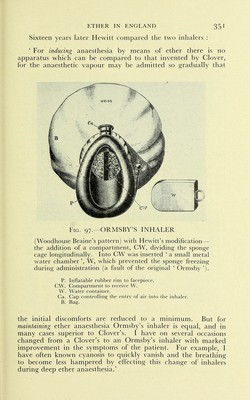
![' The Ormsby's inhaler which I myself employ . . .' Hewitt stated, ' is identical in its general construction with Mr. Wood- house Braine's pattern ; [i.e. an inhaler possessing no filling tube and having a very capacious bag of red rubber without a network covering ] but it possesses a simple internal arrange- ment . . . for preventing the temperature of the sponge becom- ing too low during administration. There has always been this objection to Ormsby's inhaler. It may, of course, be overcome by simply wringing out the sponge in hot water before commenc- ing, by warming the body of the inhaler, by replacing the frozen sponge during the administration, or by other devices. But the best plan that I know is to have the cage of the inhaler so made that it will allow of a small portable metal water-chamber being introduced. By having the sponge cage longitudinally divided into three compartments, and using the central compartment . . . for the water-chamber, the two side partitions are left for the sponge or sponges. By placing the little chamber in warm water for a few minutes it takes up heat, and will thus either prevent the tendency of the sponge to freeze, or, should it have become frozen, will quickly thaw it. . . . If one has a hand basin of hot water it is very easy to keep the water-chamber warm by immers- ing it and replacing it from time to time.' 1 While anaesthetists in England and Ireland were thus busily developing what Hewitt termed the ' close ' methods of adminis- tration, and which he defined as the use of a ' bag inhaler . . . so that to-and-fro breathing is permitted, and the supply of air during the inhalation of ether-vapour is intentionally restricted ', in America the first signs of a tendency towards ' open ' methods of etherization (see Appendix D) with free access of air were just beginning to be noticeable. The inhaler which marked the inception of this new phase in American anaesthesia was O. H. Allis's, although in fact the large ' dead space ' in the inhaler allowed carbon dioxide from the patient's exhalations to accumulate. ' The instrument', wrote Laurence Turnbull, ' was first exhibited before the Phila- delphia County Medical Society on October 14, 1874, and described in a paper . . . published in the Philadelphia Medical Times, No. 162 '. It consisted of a stout metal cage-work, oval in section and ' sufficiently large to cover the lower part of the face. A bandage was laced between the bars (which were \ inch broad and \ inch apart) across and across ' dividing the instrument into parallel sections ' lengthwise. When the lacing](https://iiif.wellcomecollection.org/image/b20457200_0376.jp2/full/800%2C/0/default.jpg)