The development of inhalation anaesthesia : with special reference to the years 1846-1900... / [Barbara M. Duncum].
- Duncum, Barbara M.
- Date:
- 1947
Licence: In copyright
Credit: The development of inhalation anaesthesia : with special reference to the years 1846-1900... / [Barbara M. Duncum]. Source: Wellcome Collection.
490/664 page 470
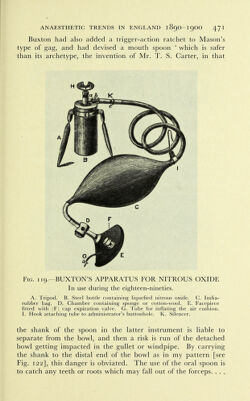
![In this last-mentioned sphere of activity Buxton had to his credit by 1900 : 1. An improved apparatus for giving nitrous oxide alone. It was essentially composed of a tripod, a fifty-gallon steel cylinder of compressed gas, a length of wide-bore ' mohair ' tubing, a Cattlin's bag fitted with a hook to suspend it from the lapel, and a Clover's facepiece with an ' expiratory valve of peculiar [but unspecified] construction '. Speaking of the apparatus as a whole Buxton stated : . . Its main peculiarities are that (1) it is provided with an efficient silencer [fixed to the outlet tube of the cylinder] which ensures absolute quietude, (2) it is adapted for gas only, and so offers no temptation to the administrator to give only a whiff of ether , (3) it possesses a special contrivance to filter the air, and, if necessary, to impregnate the gas with aromatic or other vapours.' This * contrivance ', which was situated between the bag and the facepiece, consisted of ' a chamber made in metal and opened or closed by a valve, permitting either air or nitrous oxide gas to enter. In this chamber are placed pieces of fine honey- combed sponge or teased-out medicated cotton-wool. These substances can be moistened with lavender water, eau de Cologne, or with sal volatile, or liq. ammoniae dil.—if a stimulating action is needed '. 2. A Clover's gas-ether inhaler ' the feature of which is that it can be taken entirely to pieces and completely cleansed after use '. 3. A Junker's chloroform inhaler which, Buxton stated, ' I have now employed for some years and which I have found to answer better than any of the older patterns. It consists of a somewhat larger Junker's bottle than usually supplied. The Skinner's mask [a substitute suggested by Krohne and Sesemann for the original half-spherical vulcanite type of facepiece] is re- placed by a glass face-piece (after Vajna of Buda-Pesth) to which is fixed a metal rim carrying the air supply tube, and this delivers into a perforated tube running from back to front of the metal frame. There is a hinged rim, which can be raised to allow a piece of lint or domette being placed over the opening on the upper aspect of the mask. When this rim is shut down it locks itself and keeps the lint in position. This apparatus can be rendered sterile by boiling \1 1 Buxton, D. W. 1900, Anaesthetics: their uses and administration. London. 58-9, 118, 176.](https://iiif.wellcomecollection.org/image/b20457200_0494.jp2/full/800%2C/0/default.jpg)