The development of inhalation anaesthesia : with special reference to the years 1846-1900... / [Barbara M. Duncum].
- Duncum, Barbara M.
- Date:
- 1947
Licence: In copyright
Credit: The development of inhalation anaesthesia : with special reference to the years 1846-1900... / [Barbara M. Duncum]. Source: Wellcome Collection.
626/664 page 606
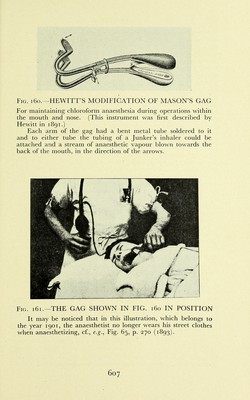
![next step was to subdue this tendency by cautiously administering chloroform from Junker's inhaler, either through the nose or into the mouth, according to Mills's plan, Operative pro- cedure was begun when the patient was deeply under the ether ; but the subsequent chloroform anaesthesia was kept only £ moderately deep '. ' Before changing to chloroform, the anaesthetist should ascertain whether respiration is taking place through the mouth or nose. It is obviously next to useless to insert the tube of Junker's apparatus into, or place lint sprinkled with chloroform over the mouth, when respiration is taking place through the nose. Generally speaking, it is best to pass a flexible silk catheter of fairly large bore through the anterior nares so that its free end may be felt just beyond the soft palate. It is easier to maintain anaesthesia by this means than by the use of a mouth tube. Should the anaesthetist prefer the latter ... he must be careful to see that respiration is oral, and if necessary the anterior nares should be plugged with lint.f1] As regards the depth of anaes- thesia during the chloroformisation, it may be said that, putting aside such delicate operations as those for cleft-palate, slight phonation, occasional cough, and frequent swallowing move- ments are to be encouraged, provided they be not accompanied by movement. . . .' Under (2)—posture ; avoidance of blood entering the larynx and trachea—Hewitt enumerated eleven positions of the patient, in which operations on the mouth, nose, and throat 6 may be and are performed '. ' Of all postures, however, the lateral is undoubtedly the best so far as the anaesthetist is concerned. The patient should be placed strictly upon his side, with his legs flexed and with one cheek resting on the pillow, the open mouth being turned so that it directly faces a window. Owing to the facility with which all blood flows out of the mouth, sponging is generally unnecessary ; and it is possible to keep up a deep and uninterrupted anaesthesia throughout by means of Junker's inhaler. . . . Semi-recumbent or propped up postures . . . are open to considerable objection from the anaesthetist's point of view, for when patients 1 For inducing anaesthesia with chloroform in operations ' within or about tne mouth, nose, or pharynx instead of the usual types of mouth-tube Hewitt preferred to use an apparatus of his own invention. This was first described by him in 1891 : ' bent metal tubes are brazed to the arms of an ordinary Mason's gag, and to one of these tubes the india-rubber piping of Junker's apparatus is attached. The chloro- form vapour is thus transmitted to the back of the throat along the arms of the gag.' (See Figs. 160-1.). (Hewitt, F. W. 1901. Anaesthetics and their administration. 320.)](https://iiif.wellcomecollection.org/image/b20457200_0638.jp2/full/800%2C/0/default.jpg)