The mechanism of the ossicles of the ear and the mebrana tympani / by H. Helmholtz ; translated from the German, with the author's permission, Albert H. Buck and Normand Smith.
- Date:
- 1873
Licence: Public Domain Mark
Credit: The mechanism of the ossicles of the ear and the mebrana tympani / by H. Helmholtz ; translated from the German, with the author's permission, Albert H. Buck and Normand Smith. Source: Wellcome Collection.
Provider: This material has been provided by the Royal College of Physicians of Edinburgh. The original may be consulted at the Royal College of Physicians of Edinburgh.
73/84 page 67
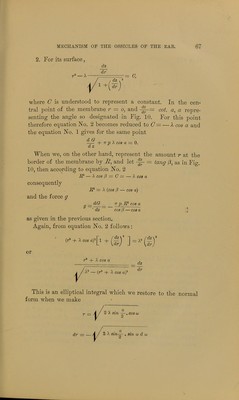
![where C is understood to represent a constant. In the cen- tral point of the membrane r = o, and cot. a, a repre- senting the angle so designated in Fig. 10. For this point therefore equation No. 2 becomes reduced to C — — X cos a and the equation No. 1 gives for the same point d G , , „ d z When we, on the other hand, represent the amount r at the border of the membrane by R, and let ~ — tang /3, as in Fig. 10, then according to equation No. 2 122 — A cos /3 = G = — A cos a consequently JR? — A (cos (3 — cos a) and the force g _ dG__ p It1 cos a ‘ dz cos (3 — cos a J as given in the previous section. Again, from equation No. 2 follows : or «-+1-<!+(!)■ ]=»•(§)’ r1 + A cos a A2 — (r2 + A cos a)2 dz dr This is an elliptical integral which we restore to the normal form when we make](https://iiif.wellcomecollection.org/image/b2193440x_0073.jp2/full/800%2C/0/default.jpg)


 No text description is available for this image
 No text description is available for this image
 No text description is available for this image